


Minimize the Error – Codeforces Round 474 (Div. 2)
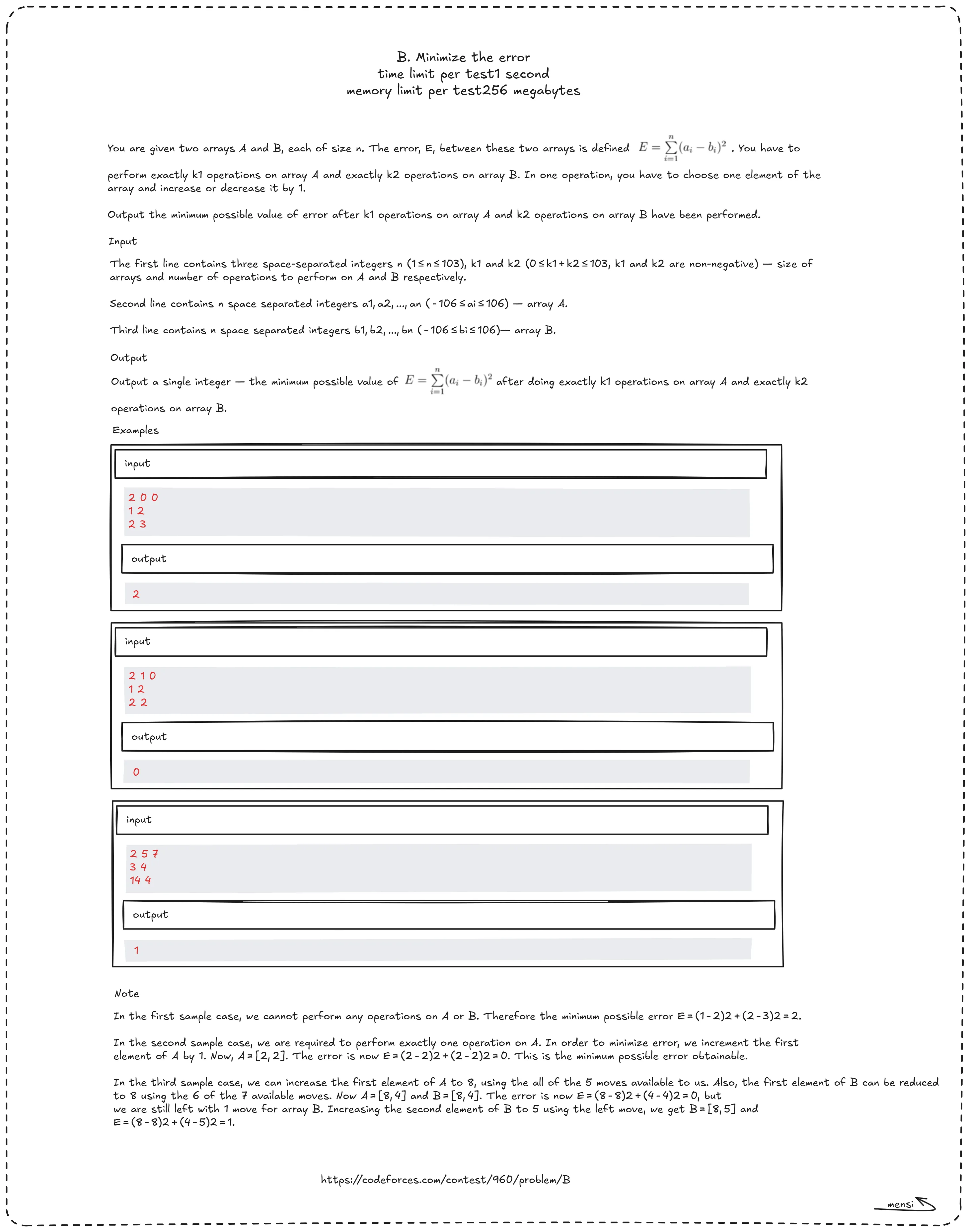
Problem Summary
We are given two arrays:
- of size
- of size
The error between them is:
We must perform:
- exactly operations on array
- exactly operations on array
In one operation, we can choose an element and either:
- increase it by
- decrease it by
We must output the minimum possible value of after exactly operations.
Key Observation
The error depends only on the differences:
Because:
So the problem becomes:
We have an array of differences We must perform exactly operations. In one operation we can modify one by 1.
How Does One Operation Affect ?
If we change or by , the difference changes by:
- either decrease by 1
- or increase by 1
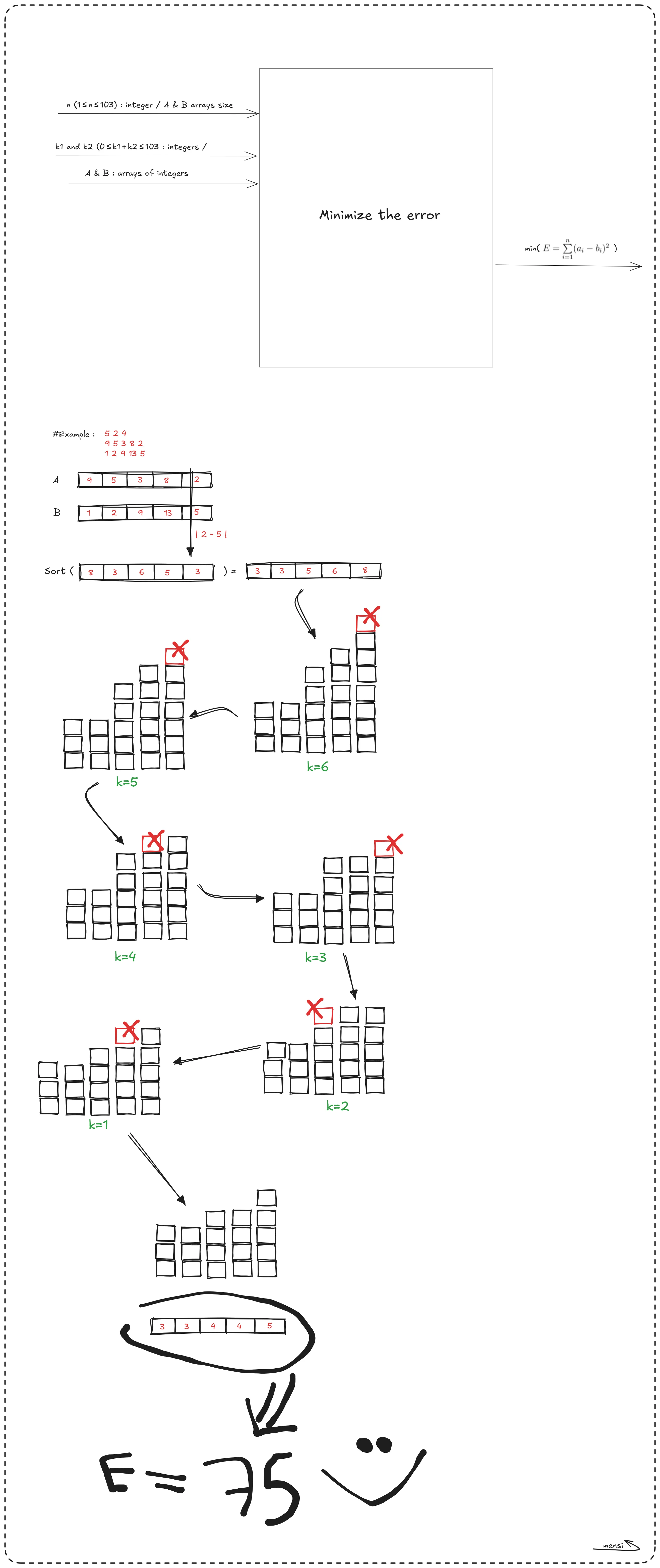
But to minimize the error, we always want to reduce the biggest difference.
So the best move is always:
- pick the maximum
- reduce it by 1 (if possible)
Special Case: When the Maximum Difference is 0
If all differences become zero but we still have remaining operations, then:
- any operation will make a become
So:
- if , then after one operation it becomes
That is why the greedy rule is:
- if → do
- else → do
Greedy Strategy
At every step:
- choose the largest difference
- reduce it by 1 (or increase if it’s already 0)
- put it back
This greedy is correct because:
- the function grows very fast
- reducing a large value decreases the total sum much more than reducing a small one
Example:
- decreasing to reduces error by 19
- decreasing to reduces error by 3
So we always want to reduce the biggest value first.
Why Use a Max Heap?
We need to repeatedly get the maximum difference quickly.
A max heap supports:
- extract maximum:
- insert:
So total complexity:
Where:
So this is very fast.
Algorithm
For each test case:
- Read
- Read arrays and
- Compute differences:
-
Insert all into a max heap
-
Repeat times:
- extract maximum
- if decrease it
- else increase it
- insert it back
-
Compute final answer:
Complexity Analysis
- Building heap:
- Each operation: extract + insert =
- Total operations:
So:
With constraints:
This runs easily within limits.
Memory:
Final C Code (Heap Solution)
#include <stdio.h>#include <stdlib.h>
struct Heap { int* arr; int size; int capacity;};typedef struct Heap heap;
typedef struct { int a; int b; int diff;} Pair;
heap* createHeap(int capacity, int* nums);void insertHelper(heap* h, int index);void maxHeapify(heap* h, int index);int extractMax(heap* h);void insert(heap* h, int data);void printHeap(heap* h);
int cmp(const void *x, const void *y);
int main(){ int n, k1, k2; scanf("%d %d %d", &n, &k1, &k2);
int A[n], B[n], C[n];
for (int i = 0; i < n; i++) scanf("%d", &A[i]);
for (int i = 0; i < n; i++) scanf("%d", &B[i]);
Pair arr[n];
for (int i = 0; i < n; i++) { arr[i].a = A[i]; arr[i].b = B[i]; arr[i].diff = abs(A[i] - B[i]); }
qsort(arr, n, sizeof(Pair), cmp);
for (int i = 0; i < n; i++) { A[i] = arr[i].a; B[i] = arr[i].b; }
for (int i = 0; i < n; i++) { C[i] = arr[i].diff; }
heap* h = createHeap(n, C);
int k = k1 + k2;
for (int i = 0; i < k; i++) { int x = extractMax(h); if (x > 0) x--; else x++;
insert(h, x); }
long long E = 0;
for (int i = 0; i < h->size; i++) { long long x = h->arr[i]; E += x * x; }
printf("%lld\n", E);
return 0;
}
heap* createHeap(int capacity, int* nums){ heap* h = (heap*)malloc(sizeof(heap)); if (h == NULL) { printf("Memory error\n"); return NULL; }
h->size = capacity; h->capacity = capacity;
h->arr = (int*)malloc(capacity * sizeof(int)); if (h->arr == NULL) { printf("Memory error\n"); free(h); return NULL; }
for (int i = 0; i < capacity; i++) h->arr[i] = nums[i];
// Build heap for (int i = (h->size - 2) / 2; i >= 0; i--) maxHeapify(h, i);
return h;}
void insertHelper(heap* h, int index){ if (index == 0) return;
int parent = (index - 1) / 2;
if (h->arr[parent] < h->arr[index]) { int temp = h->arr[parent]; h->arr[parent] = h->arr[index]; h->arr[index] = temp;
insertHelper(h, parent); }}
void maxHeapify(heap* h, int index){ int left = index * 2 + 1; int right = index * 2 + 2; int max = index;
if (left < h->size && h->arr[left] > h->arr[max]) max = left;
if (right < h->size && h->arr[right] > h->arr[max]) max = right;
if (max != index) { int temp = h->arr[max]; h->arr[max] = h->arr[index]; h->arr[index] = temp;
maxHeapify(h, max); }}
int extractMax(heap* h){ if (h->size == 0) { printf("Heap is empty.\n"); return -999; }
int deleteItem = h->arr[0]; h->arr[0] = h->arr[h->size - 1]; h->size--;
maxHeapify(h, 0); return deleteItem;}
void insert(heap* h, int data){ if (h->size >= h->capacity) { printf("Heap is full.\n"); return; }
h->arr[h->size] = data; h->size++;
insertHelper(h, h->size - 1);}
void printHeap(heap* h){ for (int i = 0; i < h->size; i++) printf("%d ", h->arr[i]); printf("\n");}int cmp(const void *x, const void *y){ Pair *p1 = (Pair *)x; Pair *p2 = (Pair *)y; return p1->diff - p2->diff;}
Takeaways
- The problem only depends on the differences .
- Minimizing the sum of squares requires always reducing the maximum difference.
- A max heap is perfect to repeatedly extract the current maximum efficiently.
- If all values become but operations remain, the answer increases (because we must still perform operations).
This greedy + heap approach is the standard optimal solution for this problem.