


Cyclists – Codeforces Round 1086 (Div. 2) Writeup
Problem Summary
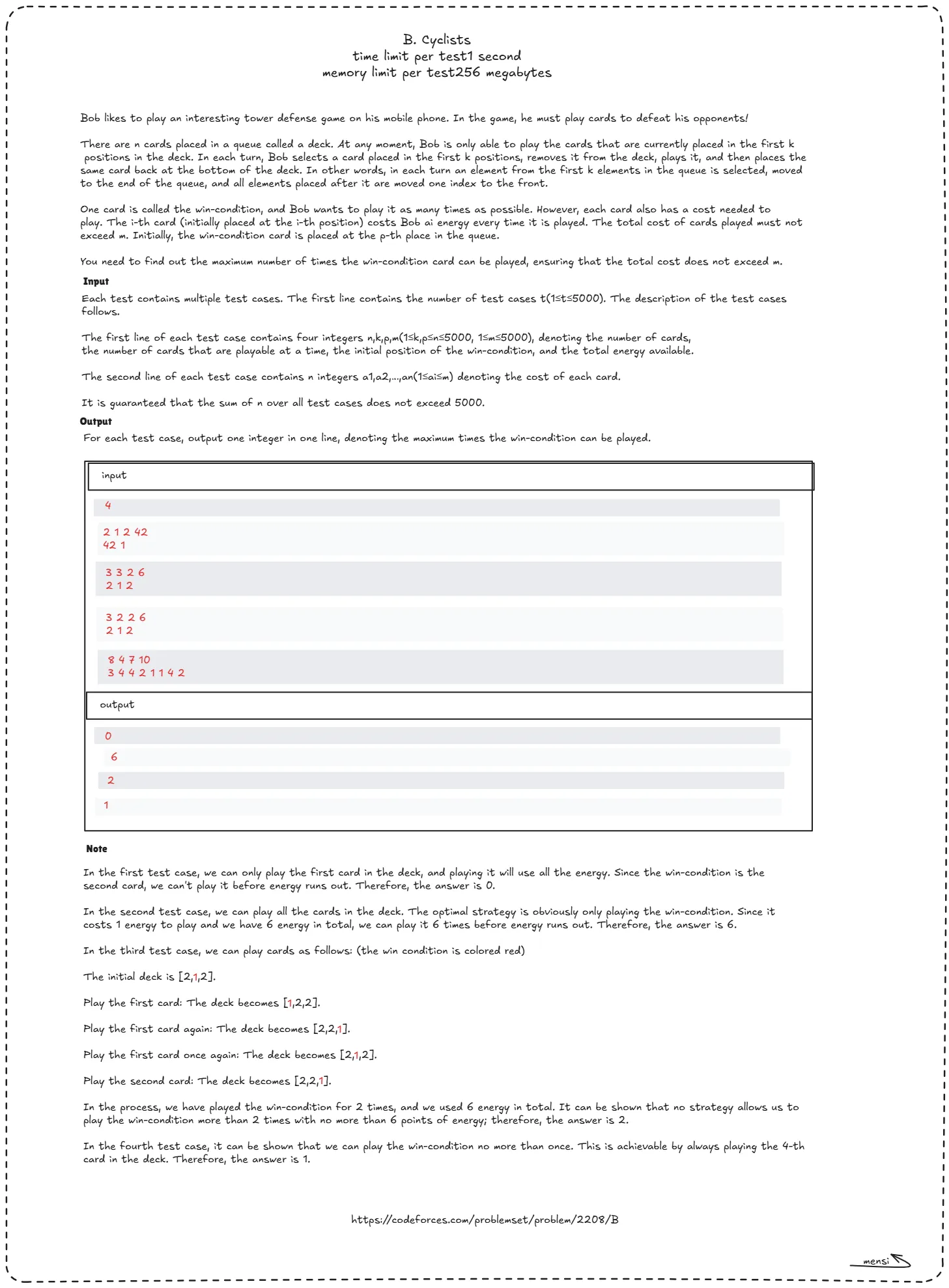
Bob is playing a mobile card game with n cards arranged in a queue (deck). He can only pick cards from the first k positions of the deck at any moment. Each card costs energy to play, and one special card (the win-condition) is at position p. After playing a card, it goes to the end of the deck.
Bob wants to play the win-condition card as many times as possible without exceeding a total energy limit of m.
We are given multiple test cases. For each, we must determine the maximum times the win-condition card can be played.
Constraints:
- test cases
- ,
- (cost of each card)
- Sum of n over all test cases ≤ 5000
Output: For each test case, print one integer, the maximum times the win-condition card can be played.
Observations
- The naive idea of always picking the win-condition card may fail if it is not in the first k cards.
- If the win-condition is beyond the first k, we need to remove cheaper cards in front of it to bring it within reach.
- If multiple cards have the same cost as the win-condition, we must track the exact index of the win-condition card, not just its value, because card costs can repeat.
Key insight: simulate the game while tracking the win-condition by its position. Whenever a card is removed before it, the index shifts left; if the card is played, it moves to the end.
Step-by-Step Solution
-
Read t test cases.
-
For each test case:
-
Track the win-condition index (
win_pos = p-1). -
While we have energy (
money >= 0):-
If the win-condition is in the first k cards:
- Pay its cost, increment the counter, move it to the end (
win_pos = n-1).
- Pay its cost, increment the counter, move it to the end (
-
Otherwise:
- Pick the cheapest card among the first k, pay its cost, move it to the end.
- Adjust win_pos if a card before it was removed.
-
-
-
Print the total times the win-condition card was played.
Example Walkthrough
Input:
42 1 2 4242 13 3 2 62 1 23 2 2 62 1 28 4 7 103 4 4 2 1 1 4 2Output:
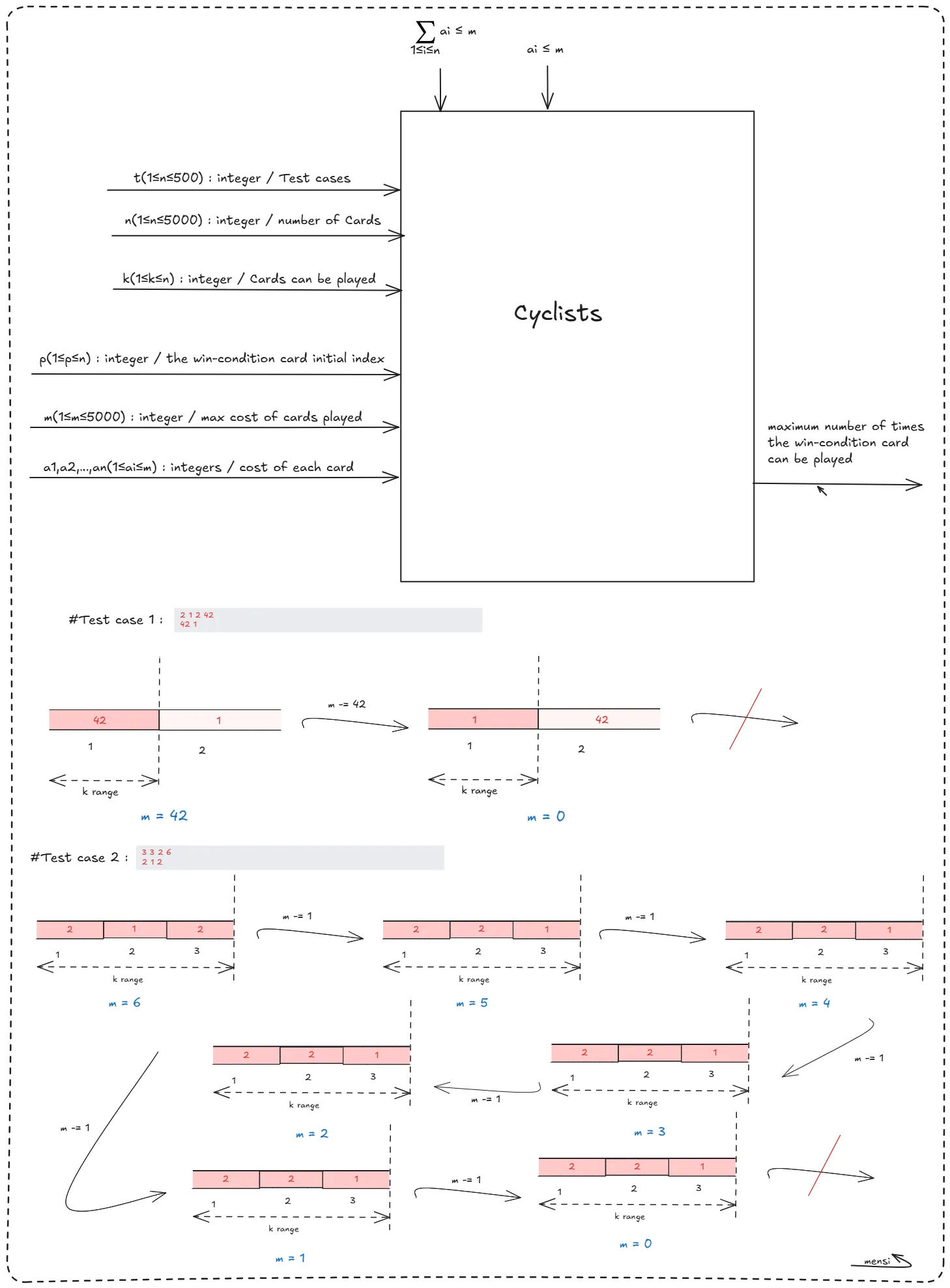
0621- Test case 1: Only the first card can be played. Win-condition is second → can’t play → 0.
- Test case 2: Win-condition is already in first 3; energy allows 6 plays → 6.
- Test case 3: Must remove first card once, then win-condition is playable → 2.
- Test case 4: Only one energy-efficient path → play win-condition once → 1.
Code Implementation (Python)
t = int(input())for _ in range(t): n, k, p, m = map(int, input().split()) deck = list(map(int, input().split()))
win_pos = p - 1 # track the winning card by index money = m count = 0
while True: if win_pos < k: cost = deck[win_pos] if money < cost: break money -= cost count += 1 deck.pop(win_pos) deck.append(cost) win_pos = n - 1 else: pickable = deck[:k] min_cost = min(pickable) if money < min_cost: break idx = pickable.index(min_cost) money -= min_cost deck.pop(idx) deck.append(min_cost) if idx < win_pos: win_pos -= 1
print(count)Explanation
- Track the win-condition by index, not value.
- Adjust
win_poswhenever a card before it is removed. - Pick cheapest card if the win-condition is not within first k.
- Count how many times the win-condition card is played before energy runs out.
Complexity Analysis
- Time complexity: in worst case, since we check the first k cards repeatedly.
- Space complexity: per test case.
Given constraints, this simulation is efficient enough.
Takeaways
- When items have duplicate values, always track them by position to avoid ambiguity.
- Greedy simulations often require careful index adjustments.
- A small, correct simulation beats a complex formula in tricky games like this.